Applied Precalculus MTH 103

Section 1.5 The Average Rate of Change

The notion of a rate of change is central to mathematics and its applications. Roughly speaking, a rate of change tells us how fast and in what manner a given quantity is changing with respect to another changing quantity. We will consider three examples below.
  • Suppose that a population of a town grows by \(200\) people each year. Here, the rate of change of the population with respect to time is constant and equal to \(200\) people/year.
  • Recall ExampleΒ 1.1.6. A daily pediatric dose of Amoxicillin, \(D\text{,}\) in milligrams, depends on the weight of a patient, \(w\text{,}\) in kilograms. More precisely, \(D=50w\text{.}\) How fast does the dose increase as the weight increases? The formula for \(D\) clearly shows that for each 1 kilogram increase in weight, the dose increases by 50 milligrams. In this case, the rate of change of \(D\) with respect to weight \(w\) is \(50\) milligrams/kilogram.
  • Suppose that the value of your car changes at the rate \(-1500\) dollars/year. The rate of change is negative, meaning that the value of the car decreases by \(1500\) dollars each year. In general, a quantity that changes at a negative rate is decreasing while one that changes at a positive rate is increasing.
In the three examples above, the rate of change of the dependent variable with respect to the independent variable is constant. In real-life processes, this is rarely the case.
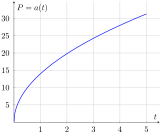
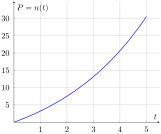
Consider the following example of two students, Amir and Nick, who went to the library to study for a precalculus exam. After \(t\) hours of uninterrupted study, Amir mastered \(P=a(t)\) pages of new material from the textbook while Nick mastered \(P=n(t)\) pages. The graphs of the two functions \(a(t)\) and \(n(t)\) are in FigureΒ 1.5.1.
A short description.
Figure 1.5.1.
According to the graphs, both students stayed in the library for 5 hours. We can see that during the 5-hour session, both students learned about 30 new pages, as \(a(5)\approx 30\) and \(n(5)\approx 30\text{.}\)
During the first hour, Amir mastered approximately
\begin{equation*} a(1)-a(0)=15-0=15 \end{equation*}
pages of new material, while Nick mastered approximately
\begin{equation*} n(1)-n(0)=3-0=3 \end{equation*}
pages. Comparatively speaking, Amir learned quickly during the first hour, while Nick learned more slowly.
During the last hour, Amir mastered approximately
\begin{equation*} a(5)-a(4)=30-27=3 \end{equation*}
pages of new material, while Nick mastered approximately
\begin{equation*} n(5)-n(4)=30-20=10 \end{equation*}
pages.
This means that Amir went from learning quickly at the beginning of the study session to learning more slowly as time went on. Nick, on the other hand, got off to a slow start but picked up the pace as time went on. Their learning patterns are clearly not identical.
Does it make sense to ask how quicklyβ€”or at what rate in pages per hourβ€”each student learned during the 5-hour session? Not really. The question is ambiguous. When exactly in the study session should we focus on? The beginning? The end? For both students, the rate at which they were learning during the session changed, with Amir learning more and more slowly over time and Nick learning faster and faster.
What does make sense is to consider how quickly each student learned during the 5-hour session on average. Amir learned quickly at first and then more slowly later, but overall he mastered 30 pages of new material in 5 hours. He learned at an average rate of \(\frac{30}{5}=6\) pages/hour. Nick, on the other hand, learned slowly at first, then faster, but he also mastered 30 pages in 5 hours. So, he too learned at an average rate of \(\frac{30}{5}=6\) pages/hour.
Readers who proceed to Calculus will study instantaneous rate of changeβ€”how quickly a quantity changes at a specific input. For now, the average rate of change is the best we can do.

Definition 1.5.2. Average Rate of Change.

Let \(y\) be a function of \(x\text{,}\) \(y=f(x)\text{.}\) Let \(x=a\) and \(x=b\) be given. The average rate of change of \(y\) between \(x=a\) and \(x=b\) is given by
\begin{equation*} \aroc = \dfrac{\text{Change in } y}{\text{Change in } x}=\dfrac{\Delta y}{\Delta x}=\dfrac{f(b)-f(a)}{b-a}. \end{equation*}
We’ll use \(\aroc\) to abbreviate Average Rate of Change.
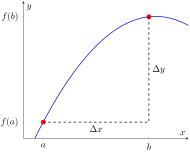
Typically, the symbol \(\Delta\) (the Greek letter Delta) is used to mean β€œchange in.” So, \(\Delta y\) stands for a change in \(y\) while \(\Delta x\) stands for a change in \(x\text{.}\) In the definition above, \(\Delta x\) stands for the change in \(x\) between \(x=a\) and \(x=b\text{.}\) This can be thought of as the distance between the numbers \(a\) and \(b\text{,}\) which is given by \(\Delta x=b-a\text{.}\) The notation \(\Delta y\) stands for the change in \(y=f(x)\) that takes place as \(x\) changes from \(x=a\) to \(x=b\text{.}\) That change is given by \(\Delta y=f(b)-f(a)\text{.}\) The graph below illustrates the changes in \(x\) and \(y\text{.}\)

Instructions.

Change the values of \(a\) and \(b\) to see how the \(\aroc\) changes.
Figure 1.5.3.
A short description.

Example 1.5.4.

Let \(y=f(x)=x^{2}-2\text{.}\) Find the average rate of change of \(y\) between \(x=1\) and \(x=3\text{.}\)
Solution.
We use the definition of the average rate of change with \(a=1\text{,}\) \(b=3\) and \(y=f(x)=x^{2}-2\text{:}\)
\begin{equation*} \dfrac{\Delta y}{\Delta x}=\dfrac{f(3)-f(1)}{3-1}=\dfrac{(3^2-2)-(1^2-2)}{3-1}=\dfrac{7-(-1)}{2}=\dfrac{8}{2}=4 \end{equation*}
Therefore, the average rate of change of \(y\) between \(x=1\) and \(x=3\) is \(4\text{.}\)
This is not an applied example so \(x\) and \(y\) don’t have real-life units. In general, the average rate of change \(\dfrac{\Delta y}{\Delta x}\) is measured in
\begin{equation*} \text{units of }\aroc = \frac{\text{units for } y}{\text{unit for } x} \end{equation*}
Were units associated with \(x\) and \(y\) in the last example, we would write that the average rate of change of \(y\) between \(x=1\) and \(x=3\) is \(4 \; \frac{\text{units for } y}{\text{units for } x}\text{.}\)
Let’s revisit ExampleΒ 1.1.5 about nicotine leaving the body after a cigarette is smoked.

Example 1.5.5.

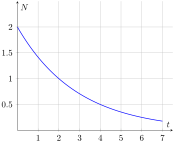
The amount of nicotine in a person’s bloodstream, \(N = f (t)\text{,}\) in milligrams, is a function of the time \(t\text{,}\) in hours, that has passed since the person smoked a single cigarette. The graph of the function \(f(t)\) is shown below.
A short description.
Use the graph to find and interpret the average rate of change of \(N\) between:
  1. \(t=0\) and \(t=4\text{;}\)
  2. \(t=2\) and \(t=4\text{.}\)
Include units with your answers.
Solution.
  1. To find the average rate of change between \(t=0\) and \(t=4\text{,}\) we use the graph to find the values of the function \(f(t)\) at \(t=0\) and at \(t=4\text{.}\) At \(t=0\text{,}\) we have \(N=f(0) = 2\) milligrams. At \(t=4\text{,}\) \(N = f(4)= 0.5\) milligrams. Thus:
    \begin{equation*} \aroc =\dfrac{\Delta N}{\Delta t}=\dfrac{f(4)-f(0)}{4-0}=\dfrac{0.5-2}{4-0}=\dfrac{-1.5}{4}=-0.375. \end{equation*}
    Here the variables are associated with units: \(N\) is measured in milligrams while \(t\) is measured in hours. Hence, \(\Delta N\) is measured in milligrams and \(\Delta t\) is measured in hours. The average rate of change has units \(\frac{\text{milligrams}}{\text{hour}}\) which can be written as \(\frac{\text{mg}}{\text{hr}}\text{.}\)
    Therefore, the average rate of change of \(N\) between \(t=0\) and \(t=4\) is
    \begin{equation*} -0.375 \, \frac{\text{mg}}{\text{hr}}. \end{equation*}
    The rate is negative as the amount of nicotine decreased between \(t=0\) and \(t=4\text{.}\) For the interpretation, we would say that on the interval \(0\leq t \leq 4\text{,}\) nicotine leaves the body at the average rate of \(0.375\) milligrams per hour.
  2. We need values \(f(2)\) and \(f(4)\text{,}\) which are obtained from the graph: \(f(2)=1\) and \(f(4)=0.5\text{.}\) Hence,
    \begin{equation*} \aroc =\dfrac{\Delta N}{\Delta t}=\dfrac{f(4)-f(2)}{4-2}=\dfrac{0.5-1}{2}=\dfrac{-0.5}{2}=-0.25 \, \frac{\text{mg}}{\text{hr}}. \end{equation*}
    On the interval \(2\leq t \leq 4\text{,}\) nicotine leaves the body at the average rate of \(0.25\) milligrams per hour.

Example 1.5.6.

A population \(P\) of a small village at time \(t\text{,}\) measured in years since the year 2010, is given by \(P=P(t)\text{.}\) Here are the annual readings:
Table 1.5.7.
\(t\) (years) \(0\) \(1\) \(2\) \(3\) \(4\) \(5\) \(6\) \(7\) \(8\) \(9\) \(10\)
\(P(t)\) (people) \(150\) \(160\) \(140\) \(180\) \(210\) \(200\) \(250\) \(290\) \(300\) \(350\) \(400\)
  1. Find the change in the population \(\Delta P\) between \(t=2\) and \(t=6\text{.}\) What are the units of \(\Delta P\text{?}\)
  2. Find the average rate of change in the population between \(t=2\) and \(t=6\text{.}\) What are the units of this rate of change?
Solution.
  1. The change in \(P\) between \(t=2\) and \(t=6\text{,}\) \(\Delta P\text{,}\) tells us by how much the population changed from \(t=2\) and \(t=6\text{:}\)
    \begin{equation*} \Delta P=P(6)-P(2)=250-140=110. \end{equation*}
    The population increased by \(110\) people from \(t=2\) to \(t=6\) (from 2012 to 2016).
  2. The average rate of change tells us how fast the population was changing between \(t=2\) and \(t=6\) and is measured in people/year:
    \begin{equation*} \aroc =\dfrac{\Delta P}{\Delta t}=\dfrac{P(6)-P(2)}{6-2}=\dfrac{250-140}{6-2}=\dfrac{110}{4}= 27.5 \, \frac{\text{people}}{\text{year}}. \end{equation*}

Example 1.5.8.

A ball is dropped from the rooftop of a building 150 feet tall. The height of the ball above the ground, \(h(t)\text{,}\) in feet, \(t\) seconds after the ball is dropped is:
\begin{equation*} h(t)=150-16t^{2}. \end{equation*}
  1. Find the average rate of change of \(h(t)\) between \(t=0\) and \(t=2\text{.}\)
  2. When will the ball hit the ground?
Solution.
  1. We use the definition of the average rate of change:
    \begin{align*} \aroc \amp \;=\; \dfrac{\Delta h}{\Delta t}\;=\; \dfrac{h(2)-h(0)}{2-0} \\ \amp \;=\; \dfrac{(150-16\cdot 2^2)-(150-16\cdot 0^2)}{2}\\ \amp \;=\; \dfrac{86-150}{2}= -32 \, \frac{\text{ft}}{\text{sec}} \end{align*}
    This can also be thought of as the average velocity of the ball between \(t=0\) and \(t=2\text{.}\) The velocity is negative because the height is decreasing.
  2. The ball hits the ground when it falls to a height of \(0\) feet, so we solve the equation \(h(t)=150-16t^{2}=0\) for \(t\text{:}\)
    \begin{align*} 150-16t^{2} \amp \; = \; 0 \\ 150 \amp \; = \; 16t^{2}\\ \dfrac{150}{16} \amp \; = \; t^{2}\\ t^{2} \amp \; = \; 9.375 \\ t \amp \; = \; \pm\sqrt{9.375} \end{align*}
    Mathematically, we get two solutions: \(t=\sqrt{9.375}\) and \(t=-\sqrt{9.375}\text{.}\) However, only one makes sense in the applied context for our problem. As \(t\) is the number of seconds after the ball is dropped, a negative answer does not make senseβ€”the ball can’t hit the ground before it was dropped! Hence, the ball hits the ground \(t=\sqrt{9.375}\approx 3.062\) seconds after it is dropped.

Exercises Exercises

1.

Find the average rate of change of each function over the indicated interval. Give your answers to two decimal places.
  1. \(f(x)=1+x^2\) between \(x=1\) and \(x=5\text{.}\)
  2. \(f(x)=1+x^2\) between \(x=-3\) and \(x=0\text{.}\)
  3. \(g(t)=\dfrac{1}{t}\) between \(t=1\) and \(t=3\text{.}\)
  4. \(p(x)=2-3x\) between \(x=1\) and \(x=5\text{.}\)
  5. \(p(x)=2-3x\) between \(x=-1\) and \(x=2\text{.}\)
Solution.
  1. \(\displaystyle 6\)
  2. \(\displaystyle -3\)
  3. \(\displaystyle -1/3\)
  4. \(\displaystyle -3\)
  5. \(\displaystyle -3\)

2.

In ExerciseΒ 1.3.8, data about the world population, in billions, between the years 2010 and 2018, was given in the table shown below. Use the data to answer the following questions.
Year \(2010\) \(2011\) \(2012\) \(2013\) \(2014\) \(2015\) \(2016\) \(2017\) \(2018\)
Population \(6.957\) \(7.041\) \(7.126\) \(7.211\) \(7.296\) \(7.380\) \(7.464\) \(7.548\) \(7.631\)
  1. What was the average rate of change of the world population between 2010 and 2012? Between 2016 and 2018? Give your answers to four decimal places and include units with your answers.
  2. Is there a one-year interval in the time period from 2010 to 2018 during which the average rate of change of the population was negative?
Solution.
  1. \(0.0845\) billion people per year; \(0.0835\) billion people per year
  2. No.

3.

A ball is dropped from a cliff above a lake. The ball’s height above the surface of the lake, \(h(t)\text{,}\) in feet, \(t\) seconds after the ball is dropped, is given by
\begin{equation*} h(t)=300-16t^2. \end{equation*}
  1. What is the average rate of change in height \(h(t)\) between \(t=0\) and \(t=3\text{?}\) Between \(t=1\) and \(t=4\text{?}\) Give units with your answers.
  2. Are your answers in part (a) positive or negative? Explain why.
Solution.
  1. \(-48\) feet per second; \(-80\) feet per second
  2. negative; the height of the ball is decreasing as time progresses (as it was dropped)

4.

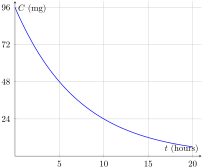
In ExerciseΒ 12, the graph of a function \(C(t)\) (provided again below) was given.
A short description.
Recall that this graph that models the amount of caffeine, in milligrams, remaining in the body \(t\) hours after drinking a cup of coffee. Use the graph to do the following.
  1. Estimate the average rate of change of \(C(t)\) between \(t=0\) and \(t=5\text{.}\) Give units with your answer.
  2. Estimate the average rate of change of \(C(t)\) between \(t=10\) and \(t=15\text{.}\) Give units with your answer.
  3. Compare the magnitudes of your answers in (a) and (b). Can you explain the difference by what you see on the graph?
Solution.
  1. \(-9.6\) mg/hr
  2. \(-2.4\) mg/hr
  3. The average rate of change from \(t = 0\) to \(t = 5\) hours is larger than the average rate of change from \(t=10\) to \(t=15\) hours. It can be seen that the rate at which the amount of caffeine in the bloodstream is changing gets smaller and smaller as time progresses.

5.

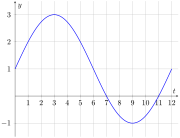
The graph of a function \(y=f(t)\) is shown below.
A short description.
Without performing any calculations, answer the following questions.
  1. Is the average rate of change of \(f(t)\) between \(t=0\) and \(t=3\) positive or negative? Explain your answer.
  2. Is the average rate of change of \(f(t)\) between \(t=3\) and \(t=6\) positive or negative? Explain your answer.
Solution.
  1. positive since the graph is increasing on this interval
  2. negative since the graph is decreasing on this interval

6.

A person’s weight, \(W\text{,}\) in pounds, depends on the number of minutes \(m\) of daily exercise. Hence, \(W=W(m)\) is a function of \(m\text{.}\) Below is a numerical representation of \(W(m)\text{:}\)
\(m\) (minutes) \(0\) \(20\) \(40\) \(60\) \(80\) \(100\) \(120\)
\(W\) (pounds) \(159\) \(152\) \(146\) \(141\) \(137\) \(136\) \(135.6\)
  1. Find the average rate of change of \(W(m)\) between \(m=0\) and \(m=40\text{.}\) Give units with your answer.
  2. Find the average rate of change of \(W(m)\) between \(m=80\) and \(m=120\text{.}\) Give units with your answer.
  3. Based on your answers and the data in the table, what can you say about the rate of weight loss with increasing amount of exercise?
Solution.
  1. \(-0.325\) pounds/minute
  2. \(-0.035\) pounds/minute
  3. The rate of weight loss slows as the daily amount of exercise increases.

7.

Worldwide sales of passenger cars fluctuated between 2012 and 2019, as can be seen in the table below.
Year \(2010\) \(2011\) \(2012\) \(2013\) \(2014\) \(2015\) \(2016\) \(2017\) \(2018\) \(2019\)
Cars Sold (millions) \(55.82\) \(57.84\) \(60.94\) \(63.43\) \(65.71\) \(66.31\) \(69.46\) \(70.69\) \(68.68\) \(64.34\)
  1. Calculate the average rate of change in sales of passenger cars between the years 2010 and 2017. Give units with your answer.
  2. Calculate the average rate of change in sales of passenger cars between the years 2017 and 2019. Give units with your answer.
  3. In what one-year intervals was the average rate of change negative?
Solution.
  1. approximately 2.124 million cars sold per year
  2. \(-3.175\) million cars sold per year
  3. from 2017 to 2018 and from 2018 to 2019

Worksheet Practice Worksheet

1.

Find the average rate of change of \(f(x)=2x^3\) from \(x=1\) to \(x=3\text{.}\)
Solution.
First, compute \(f(1)=2\) and \(f(3)=54\text{.}\) Then, the average rate of change is
\begin{equation*} \frac{f(3)-f(1)}{3-1} = \frac{54-2}{2} = 26. \end{equation*}

2.

Find the average rate of change of \(g(t)=3t^2+4\) between \(t=-2\) and \(t=1\text{.}\)
Solution.
First, compute \(g(-2) = 3(-2)^2 + 4 = 16\) and \(g(1) = 3(1)^2+4=7\text{.}\) Then, the average rate of change is
\begin{equation*} \frac{g(1)-g(-2)}{1-(-2)} = \frac{7-16}{1+2} = \frac{-9}{3} = -3. \end{equation*}

3.

The table below gives the net sales of The Gap, Inc., which operates nearly \(3000\) clothing stores.
(a)
Find the average rate of change in net sales between \(2005\) and \(2008\text{.}\) Give units and interpret your answer.
Solution.
The average rate of change from 2005 to 2008 is
\begin{equation*} \frac{14526 - 16019}{2008 - 2005} = \frac{-1493}{3} = -497.7 \text{ millions of \$} / \text{year} . \end{equation*}
This means that on average, The Gap’s net sales decreased by approximately \(497.7\) million dollars per year from 2005 to 2008.
(b)
From 2005 to 2010, were there any one-year intervals during which the average rate of change was positive? If so, when?
Solution.
Yes. From 2009 to 2010 is the only two consecutive years for which the sales increased. Therefore, this is the only one-year interval for which the ARC was positive.
4.

The graph of a function \(f(t)\) is given below.
(a)
What is the average rate of change from \(t=0\) to \(t=3\text{?}\)
Solution.
The average rate of change from \(t=0\) to \(t=3\) is
\begin{equation*} \frac{f(3)-f(0)}{3-0} = \frac{4-1}{3} = 1. \end{equation*}
(b)
What is the average rate of change from \(t=-1\) to \(t=1\text{?}\)
Solution.
The average rate of change from \(t=-1\) to \(t=1\) is
\begin{equation*} \frac{f(1)-f(-1)}{1-(-1)} = \frac{-2-4}{1+1} = -3. \end{equation*}
(c)
What is the average rate of change from \(t=1\) to \(t=4\text{?}\)
Solution.
The average rate of change from \(t=1\) to \(t=4\) is
\begin{equation*} \frac{f(4)-f(1)}{4-1} = \frac{1-(-2)}{3} = 1. \end{equation*}