Applied Precalculus MTH 103

Section 2.1 Properties of Linear Functions

Definition 2.1.1. Linear Function.

A function \(y=f(x)\) is called a linear function if it can be written in the form
\begin{equation*} f(x)=mx+b \end{equation*}
where \(m\) and \(b\) are constants. The constant \(m\) is called the slope of the function \(y=f(x)\text{.}\) The constant \(b\) is the initial value of \(f(x)\text{;}\) it is also the vertical intercept of the function as \(f(0)=m\cdot 0+b=b\text{.}\)
A linear function \(y=f(x)\) written in the form \(f(x)=mx+b\) or \(y=mx+b\) is said to be in slope-intercept form.

By the way...

Subsection Practical Interpretation of the Slope and Vertical Intercept

Applied examples of linear functions will help us understand the practical meaning of the slope \(m\) and the initial value \(b\text{.}\) In such examples, the input and output variables will often be denoted by letters that correspond to their practical meaning rather than by \(x\) and \(y\text{.}\)

Example 2.1.2.

Maya is saving money to purchase a car. She initially has \(\$60\) in savings and for each hour she works at her summer job she is able to put an additional \(\$5\) into savings. Find a formula for the function \(A=f(n)\) that gives the total amount of money, \(A\text{,}\) that Maya has in savings after working \(n\) hours.
Solution.
We begin with a table of values reflecting the total amount of money Maya will have in savings after working a certain number of hours.
Table 2.1.3.
If Maya works … Maya’s savings will be …
0 hours \(5(0)+60=\$60\)
1 hour \(5(1)+60=\$65\)
2 hours \(5(2)+60=\$70\)
3 hours \(5(3)+60=\$75\)
\(\vdots\) \(\vdots\)
Recognizing the pattern unfolding, a formula for the amount of money \(A\) that Maya has in savings as a function of the number of hours \(n\) that she works is
\begin{equation*} A=f(n)=5n+60\text{.} \end{equation*}
The function \(A=f(n)\) found in the solution to ExampleΒ 2.1.2 is a linear function with slope \(m=5\) and vertical intercept \(b=60\text{.}\) Mathematically, the domain of the function \(f(n)= 5n+60\) consists of all inputs \(n\text{,}\) but in the applied context of the function, it is not possible for Maya to work a negative number of hours. For this reason, we must restrict the domain to \(n\geq0\text{.}\)
Observe that, as in most applied examples, the input and output variables have units: \(n\) is measured in hours worked while \(A\) is measured in dollars. Likewise, both constants \(m=5\) and \(b=60\) have units and a practical meaning:
  • \(b=60\) dollars is the initial value of \(A\) at \(n=0\text{;}\) that is, the amount of money that Maya has in savings initially.
  • The slope \(m=5\) indicates that Maya saves \(\$5\) per each hour worked. Hence, the slope \(m=5\) is measured in dollars per hour and gives the rate at which Maya’s savings \(A\) grow as the number of hours \(n\) she works increases.
We can additionally observe that the average rate of change between any two distinct inputs for the function \(f(n)=5n+60\) is always the same. The below calculations illustrate this.

By the way...

\begin{align*} \aroc\text{ from } n=0 \text{ to } n=1: \amp \quad \frac{65-60}{1-0}\;=\;\frac{5}{1} \;=\; 5 \amp \quad \text{dollars}/\text{hour}\\ \aroc\text{ from } n=1 \text{ to } n=2: \amp \quad \frac{70-65}{2-1}\;=\;\frac{5}{1}\;=5\; \amp \quad \text{dollars}/\text{hour}\\ \aroc\text{ from } n=2 \text{ to } n=3: \amp \quad \frac{75-70}{3-2}\;=\;\frac{5}{1}\;=5\; \amp \quad \text{dollars}/\text{hour}\\ \aroc\text{ from } n=0 \text{ to }n=3: \amp \quad \frac{75-60}{3-0}\;=\;\frac{15}{3}\;=5 \; \amp \quad \text{dollars}/\text{hour} \end{align*}
Maya’s savings grow at a constant rate with respect to the hours that she works, and that constant rate of 5 dollars/hour is the same as the slope of the linear function \(f(n)=5n+60.\) In general, for linear functionsβ€”and only for linear functionsβ€”the rate of change of the dependent variable with respect to the independent variable is constant and equal to the slope.
The constancy of the rate of change of a linear function can be proven using algebraic properties of linear functions. Take two distinct inputs \(x_1\text{,}\) \(x_2\) and the corresponding outputs \(y_1=f(x_1)\text{,}\) \(y_2=f(x_2)\text{.}\) The average rate of change of \(f(x)\) between \(x_1\) and \(x_2\) is given by:
\begin{align*} \frac{\Delta y}{\Delta x} \; =\; \frac{f(x_2)-f(x_1)}{x_2-x_1} \amp \;=\; \frac{(mx_2+b)-(mx_1+b)}{x_2-x_1} \\ \amp \;=\; \frac{mx_2+b-mx_1-b}{x_2-x_1} \\ \amp \;=\; \frac{m(x_2-x_1)}{x_2-x_1}\\ \amp \;=\; m \end{align*}

Example 2.1.5.

The number of people residing in the town of Linesville \(t\) years after 2010 is given by the linear function
\begin{equation*} P(t)=150t+4500. \end{equation*}
Identify the slope and the initial value of the function. Include units and explain their practical meaning.
Solution.
From the formula for \(P(t)\text{,}\) we see that the slope of the function is \(m=150\) and the initial value is \(b=4500\text{.}\)
The slope \(m\) is measured in people/year. In practical terms, the slope tells us that the population of Linesville increases at a constant rate of \(150\) people per year.
The initial value \(b=4500\) is measured in number of people. It represents the initial number of residents in the town of Linesville, i.e., the number of residents at \(t=0\text{.}\) As time \(t=0\) corresponds to the year 2010, this means that the population of Linesville was 4500 people in 2010.

Example 2.1.6.

A container holding 50 gallons of water has sprung a leak. Water is leaking out at a rate of \(5\) gallons/hour. Let \(W(t)\) be the amount of water in the container, in gallons, \(t\) hours after the leak began. Find a formula for the function \(W(t)\text{.}\)
Solution.
Water is leaking out at a constant rate so \(W(t)\) is a linear function. Hence \(W(t)=mt+b\text{.}\)
The amount of water in the container is decreasing at a rate 5 gallons/hour. This means that the rate of change or slope of \(W(t)\) is \(-5\) gallons/hour. That is, \(m=-5\text{.}\)
The initial amount of water is \(W(0)=50\) gallons, so \(b=50\text{.}\) The formula for \(W(t)\) is:
\begin{equation*} W(t)=-5t+50. \end{equation*}

Subsection Graphs of Linear Functions

We will next explore the graphs of linear functions.

Example 2.1.7.

In ExampleΒ 2.1.2, Maya’s savings \(A\text{,}\) in dollars, as a function of the number of hours, \(n\text{,}\) was given by
\begin{equation*} A=f(n)=5n+60. \end{equation*}
Use TableΒ 2.1.3 to create a graph of the function \(f(n)\text{.}\)
Solution.
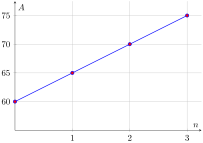
TableΒ 2.1.3 contains the points \((0,60)\text{,}\) \((1,65)\text{,}\) \((2,70)\text{,}\) and \((3,75)\text{.}\) By plotting these points, we obtain the following graph. It is clear that the points lie along a straight line.
A short description.
In the following figure, we can see how the slope and vertical intercept change the graph of the function.

Instructions.

Change the values of the vertical intercept \(b\) and the other point to see how the corresponding linear function changes.
Figure 2.1.9.

Example 2.1.10.

Consider the function \(W(t)\) from ExampleΒ 2.1.6, which gives the amount of water in a container, \(W(t)\text{,}\) in gallons, \(t\) hours after the container sprung a leak:
\begin{equation*} W(t)=-5t+50. \end{equation*}
Create a graph of the function \(W(t)\text{.}\) What restriction should be placed on the domain of \(W(t)\) in the applied context of this exercise?
Solution.
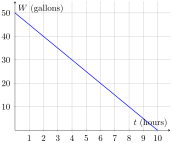
The slope \(m=-5\) is negative, and thus the graph is decreasing: for each 1 hour increase in \(t\text{,}\) \(W(t)\) decreases by \(5\text{.}\) The vertical intercept is \(b=50\) gallons. Using this information, we construct the following graph.
A short description.
The practical significance of vertical and horizontal intercepts is apparent from the graph. The vertical intercept, \(W=50\text{,}\) gives the initial amount of water in the container. The horizontal intercept, \(t=10\text{,}\) is the number of hours that must pass for the tank to empty completely. Based upon this, the domain of \(W(t)=-5t+50\) should be restricted to \(0\leq t \leq 10\) in order for the formula to make sense in the applied context of this exercise.

Subsection The Slope Formula

We are often given multiple points on the graph of a linear function but not provided the formula for the function nor explicitly told its slope. In this case, we have enough information to determine both the slope and the slope-intercept form of the function.
Given two distinct points \((x_1,y_1)\) and \((x_2,y_2)\) on the graph of a linear function \(y=f(x)\text{,}\) the average rate of change of \(f(x)\) between \(x_1\) and \(x_2\) is given by
\begin{equation*} \frac{f(x_2)-f(x_1)}{x_2-x_1} \; = \;\frac{y_2-y_1}{x_2-x_1}. \end{equation*}
Since the average rate of change between any two points on a linear function is its slope (see TheoremΒ 2.1.4), the above is the value of \(m\text{.}\)
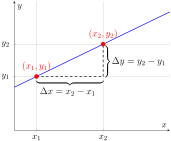
Graphically, the slope formula \(m=\dfrac{y_2-y_1}{x_2-x_1}\) is often thought of as β€œrise over run.” The β€œrise” is what we denote by \(\Delta y\) or \(y_2-y_1\text{;}\) it is the change in \(y\)-values from the ordered pair \((x_1,y_1)\) to the ordered pair \((x_2,y_2)\text{.}\) The β€œrun” is what we denote by \(\Delta x\) or \(x_2-x_1\text{;}\) it is the change in the corresponding \(x\)-values. This is illustrated below.
A short description.

Example 2.1.12.

Find the slope of the line passing through each set of points.
  1. \((-3,-1)\) and \((-2,4)\)
  2. \((2,3)\) and \((-1,3)\)
  3. \((1/2,6)\) and \((1,-1/3)\text{.}\)
Solution.
  1. If \((x_1,y_1)=(-3,-1)\) and \((x_2,y_2)=(-2,4)\) then the slope is
    \begin{equation*} m = \frac{y_2-y_1}{x_2-x_1} = \frac{4-(-1)}{-2-(-3)}=\frac{4+1}{-2+3}=\frac{5}{1}=5. \end{equation*}
  2. If \((x_1,y_1)=(2,3)\) and \((x_2,y_2)=(-1,3)\) then the slope is
    \begin{equation*} m= \frac{y_2-y_1}{x_2-x_1} = \frac{3-3}{-1-2}=\frac{0}{-3}=0. \end{equation*}
    By the way...
  3. If \((x_1,y_1)=(1/2,6)\) and \((x_2,y_2)=(1,-1/3)\) then the slope is
    By the way...
    \begin{align*} m \;=\; \frac{y_2-y_1}{x_2-x_1} \amp \;=\; \frac{-1/3-6}{1-1/2} \;=\; \frac{-1/3-18/3}{2/2-1/2} \;=\; \frac{-19/3}{1/2}\\ \amp \;=\; -\frac{19}{3}\cdot\frac{2}{1} \;=\; -\frac{38}{3}. \end{align*}

Example 2.1.13.

Find a linear function \(f(x)=mx+b\) such that \(f(1)=2\) and \(f(3)=-2\text{.}\)
Solution.
The two associated points on the graph of the function are
\begin{equation*} (x_1,y_1)=(1,2) \quad \text{and} \quad (x_2,y_2)=(3,-2) . \end{equation*}
Using the slope formula, we find that
\begin{equation*} m=\frac{y_2-y_1}{x_2-x_1}=\frac{-2-2}{3-1}=-2. \end{equation*}
So, \(f(x)=-2x+b\text{.}\) The value of \(b\) is not immediately apparent as we were not given the value of the function at \(x=0\text{.}\) However, we can solve for it by using either one of the function values provided. For instance, we can use the fact that \(f(1)=2\) to set up an equation for \(b\text{.}\) Substituting \(x=1\) into \(f(x)=-2x+b\) results in
\begin{equation*} -2\cdot 1+b=2. \end{equation*}
Adding \(2\) to both sides allows us to conclude that \(b=4\text{.}\) Therefore, \(f(x)=-2x+4\text{.}\)
Example 2.1.14.

Identify the slope and vertical intercept of each line. Then write the equation of the line in slope-intercept form.
A short description.
Solution.
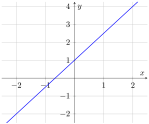
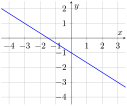
  1. The first line intersects the \(y\)-axis at the point \((0,1)\text{,}\) so the vertical intercept is \(b=1\text{.}\) To calculate the slope, find two points on the graph and use the slope formula. We’ll use \((x_1,y_1)=(0,1)\) and \((x_2,y_2)=(2,4)\text{.}\) Then
    \begin{equation*} m=\frac{y_2-y_1}{x_2-x_1}=\frac{4-1}{2-0}=\frac{3}{2} . \end{equation*}
    The equation of the line is \(y=\dfrac{3}{2}x+1\text{.}\) The corresponding linear function is \(f(x)=\dfrac{3}{2}x+1\text{.}\)
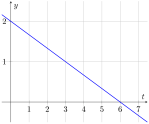
  2. For the second line, note that the variable \(t\) is being used instead of \(x\text{.}\) We must again find two points on the line to substitute into the slope formula. We’ll use \((t_1,y_1)=(0,2)\) and \((t_2,y_2)=(6,0)\) to find that
    \begin{equation*} m=\frac{y_2-y_1}{t_2-t_1}=\frac{0-2}{6-0}=\frac{-2}{6}=-\frac{1}{3} . \end{equation*}
    Since the vertical intercept is \(b=2\text{,}\) the equation of the line is \(y=-\dfrac{1}{3}t+2\text{.}\) The corresponding linear function is \(f(t)=-\dfrac{1}{3}t+2\text{.}\)

Subsection Constant Functions, Horizontal and Vertical Lines

In ExampleΒ 2.1.12, we encountered a linear function with slope 0 but did not go into great detail about what this means. To further explore the concept, consider the linear function
\begin{equation*} f(x)=3. \end{equation*}
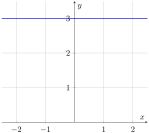
The formula for this function can be rewritten as \(f(x)=0\cdot x+3\text{.}\) The slope of this function is 0 and the \(y\)-intercept is 3. We can see that for every \(x\text{,}\) the value of the function is the same; that is, \(f(x)=3\) for all \(x\text{.}\) We say that the function \(f(x)=3\) is constant because it is constantly equal to 3. Using the rate of change interpretation of the slope of a linear function, it is unsurprising that the function is constant β€” the rate of change or slope of the function being \(m=0\) implies that the function doesn’t change.
The graph of the function \(f(x)=3\) consists of all points on the plane for which \(y=3\text{,}\) resulting in a horizontal line through the \(y\)-value 3 as depicted below.
A short description.
Having established that horizontal lines in the plane are graphs of constant functions, it is natural to wonder if vertical lines in the plane are also associated with a special type of linear function.
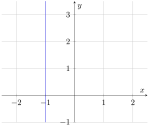
Vertical linesβ€”lines parallel to the \(y\)-axisβ€”are not graphs of functions. A vertical line consists of all points for which the \(x\)-coordinate is constant. Take for example the line \(x=-1\) which is graphed below.
A short description.

By the way...

This line is not the graph of any function \(y=f(x)\) as for the single input \(x=-1\) there is more than one outputβ€”infinitely many outputs, in fact. You can reach the same conclusion by using the Vertical Line Test. There exists a vertical line (the line \(x=-1\) itself) that crosses the graph of \(x=-1\) more than once (everywhere, actually). Therefore the graph of \(x=-1\) is not a function.
We conclude that vertical lines are not graphs of functions. Furthermore, slopes of vertical lines are undefined. Why? Take two points on the line \(x=-1\text{,}\) say \((-1,0)\) and \((-1,1)\text{.}\) The slope formula gives:
\begin{equation*} m=\frac{1-0}{-1-(-1)}=\dfrac{1}{-1+1}=\frac{1}{0} \end{equation*}
which is undefined due to division by \(0\text{.}\)

By the way...

In summary, the graph of every linear function \(y=f(x)=mx+b\) is a line in the \(xy\)-plane while every non-vertical line has an equation of the form \(y=mx+b\) and thus is the graph of a linear function. However, not every line in the plane is the graph of a linear function, since vertical lines are not functions. Sometimes people talk about linear functions and lines in the plane interchangeably. Despite the duality between lines and linear functions, it is important to remember that a linear function is a special dependence between two numerical variables that can be visually represented by a line. The converse is not necessarily true.

Exercises Exercises

Slope-Intercept Form.

For each of the following, rewrite the linear function in slope-intercept form. Then identify the slope and vertical intercept.
3.
\(\displaystyle h(t)=\frac{18t-5}{2}\)
Solution.
\(h(t)=9t-2.5\text{;}\) slope: \(9\text{;}\) vertical intercept: \(-2.5\)

Computing the Slope.

For each of the following, find the slope of the line passing through each pair of points.

Finding the Slope.

For each of the following, find the slope of the linear function corresponding to the information provided.

15.

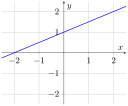
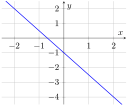
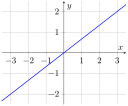
Identify the slope and vertical intercept of each line. Then write an equation of the line.
  1. A short description.
  2. A short description.
  3. A short description.
  4. A short description.
Solution.
  1. slope: \(0.5\text{;}\) vertical intercept: \(1\text{;}\) equation: \(y=0.5x+1\)
  2. slope: \(-\frac{3}{2}\text{;}\) vertical intercept: \(-1\text{;}\) equation: \(y=-\frac{3}{2}x-1\)
  3. slope: \(\frac{2}{3}\text{;}\) vertical intercept: \(0\text{;}\) equation: \(y=\frac{2}{3}x\)
  4. slope: \(-\frac{2}{3}\text{;}\) vertical intercept: \(-1\text{;}\) equation: \(y=-\frac{2}{3}x-1\)

16.

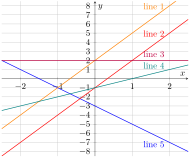
    Five linear functions are given below. Drag each function on the left to the corresponding line number on the right.
    A short description.
  • \(y=3x+2\)
  • Line 1
  • \(y=3x-1\)
  • Line 2
  • \(y=2\)
  • Line 3
  • \(y=x-1\)
  • Line 4
  • \(y=-2x-3\)
  • Line 5
Solution.
Line 1 is \(y=3x+2\text{;}\) Line 2 is \(y=3x-1\text{;}\) Line 3 is \(y = 2\text{;}\) Line 4 is \(y=x-1\text{;}\) Line 5 is \(y=-2x-3\text{.}\)

17.

During the 2019-2020 academic year, a senior lecturer at URI earned a base salary of \(\$55,683\) for a standard teaching load. For each credit taught in excess of the standard load, \(\$1,567\) were added to his salary. Write a linear equation expressing the total amount \(A\) that the senior lecturer earned for teaching \(n\) credits in excess of the standard workload during the 2019-2020 academic year.
Solution.
\(A=1567n+55683\)

18.

The elevation in feet, \(E(t)\text{,}\) of a hiker \(t\) minutes after beginning her hike is given by \(E(t)=35t+1350\text{.}\)
  1. Write a complete sentence explaining the practical meaning of the vertical intercept of this linear function. Include units in your answer.
  2. Write a complete sentence explaining the practical meaning of the slope of this linear function. Include units in your answer.
Solution.
  1. The initial elevation of the hiker is 1350 feet.
  2. The hiker’s elevation is increasing at a rate of 35 feet per minute.

19.

The distance in miles from the finish line, \(D(t)\text{,}\) of a bicyclist \(t\) hours after beginning a race is given by \(D(t)=50-25t\text{.}\)
  1. Write a complete sentence explaining the practical meaning of the vertical intercept of this linear function. Include units in your answer.
  2. Write a complete sentence explaining the practical meaning of the slope of this linear function. Include units in your answer.
Solution.
  1. The bicyclist’s initial distance from the finish line is 50 miles.
  2. The bicyclist’s distance from the finish line is decreasing at a rate of 25 miles per hour.