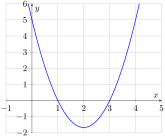
The graph gives us the horizontal intercepts or equivalently the zeros of the function \(f(x)\text{:}\) \(x = 1\) and \(x = 3\text{.}\) Hence, \(f(x)\) in factored form is:
\begin{equation*}
f(x) = a ( x - 1 ) ( x - 3 )
\end{equation*}
We still don’t have the value of the leading coefficient \(a\text{.}\) To find \(a\text{,}\) we will use the vertical intercept \(y = 5\) of the function. The intercept is clearly seen on the graph. The vertical intercept is the value of the function at \(x = 0\text{.}\) Thus, \(f(0) = 5\text{.}\) We substitute \(x = 0\) into factored form of \(f(x)\) and obtain:
\begin{equation*}
a ( 0 - 1 ) ( 0 - 3 ) = 5
\end{equation*}
We simplify the equation:
\begin{equation*}
a \cdot ( -1 ) \cdot ( -3 ) = 5
\end{equation*}
which gives:
\begin{equation*}
a \cdot 3 = 5
\end{equation*}
and finally:
\begin{equation*}
a = \frac{5}{3}
\end{equation*}
The function \(f(x)\) in factored form is:
\begin{equation*}
f(x) = \frac{5}{3} ( x - 1 ) ( x - 3 )
\end{equation*}
To obtain \(f(x)\) in standard form, we multiply out all terms and simplify:
\begin{align*}
f(x) \amp = \frac{5}{3} ( x - 1 ) ( x - 3 ) \\
\amp = \frac{5}{3} ( x^2 - 3x - x + 3 ) \\
\amp = \frac{5}{3} ( x^2 - 4x + 3 ) \\
\amp = \frac{5}{3} x^2 - \frac{20}{3} x + 5.
\end{align*}