
Applied Precalculus MTH 103

Section 3.2 Factoring Quadratic Expressions

In order to algebraically solve for the horizontal intercepts of a quadratic function such as
\begin{equation*} f(x)=x^2+5x+6 \end{equation*}
one must set \(f(x)\) equal to \(0\) and then solve for \(x\text{;}\) in other words, one must solve the quadratic equation
\begin{equation*} x^2+5x+6=0. \end{equation*}
This equation can be solved by factoring. This process will be explained below.
When we multiply together
\begin{equation*} (x+M)(x+N) \end{equation*}
for some real numbers \(M\) and \(N\text{,}\) we obtain:
So if one begins with a quadratic expression of the form \(x^2+Bx+C\) and wants to find two numbers \(M\) and \(N\) such that
\begin{equation*} x^2+Bx+C=(x+M)(x+N), \end{equation*}
it must be the case that \(M+N=B\) and \(M\cdot N=C\text{.}\)

Example 3.2.2.

Factor each quadratic expression.
  1. \(\displaystyle x^2+5x+6\)
  2. \(\displaystyle t^2-16t+64\)
  3. \(\displaystyle w^2+8w-20\)
Solution.
  1. We need to find two numbers whose product is \(C=6\) and whose sum is \(B=5\text{.}\) Since \(2\cdot3=6\) and \(2+3=5\text{,}\) we have
    \begin{equation*} x^2+5x+6=(x+2)(x+3). \end{equation*}
  2. We need to find two numbers whose product is \(C=64\) and whose sum is \(B=-16\text{.}\) Since \(-8\cdot(-8)=64\) and \(-8+(-8)=-16\text{,}\) we have
    \begin{equation*} t^2-16t+64=(t-8)(t-8)=(t-8)^2. \end{equation*}
  3. We need to find two numbers whose product is \(C=-20\) and whose sum is \(B=8\text{.}\) Since \(-2\cdot10=-20\) and \(-2+10=8\text{,}\) we have
    \begin{equation*} w^2+8w-20=(w-2)(w+10). \end{equation*}

Example 3.2.3.

Find the horizontal intercepts of each quadratic function.
  1. \(\displaystyle f(x)=x^2+5x+6\)
  2. \(\displaystyle y=z^2-49\)
Solution.
  1. To find the horizontal intercepts, we set the function equal to 0 and solve for \(x\text{:}\)
    \begin{equation*} x^2+5x+6=0. \end{equation*}
    We factored the left-hand side of this equation inExampleΒ 3.2.2 (a), so
    \begin{equation*} (x+2)(x+3)=0. \end{equation*}
    \begin{align*} x+2\amp=0 \amp\qquad x+3 \amp= 0\\ x+2\textcolor{blue}{-2}\amp=0\textcolor{blue}{-2} \amp\qquad x+3\textcolor{blue}{-3} \amp= 0\textcolor{blue}{-3}\\ x\amp=-2 \amp\qquad x\amp=-3 \end{align*}
    Hence the horizontal intercepts of \(f(x)=x^2+5x+6\) are \(x=-3\) and \(x=-2\text{.}\)
  2. Again, we set the quadratic function equal to 0 and solve:
    \begin{equation*} z^2-49=0. \end{equation*}
    In order to factor the left-hand side, we note that \(z^2-49=z^2+0z-49\text{,}\) so we need two numbers whose product is \(C=-49\) and whose sum is \(B=0\text{.}\) Since \(-7\cdot 7=-49\) and \(-7+7=0\text{,}\) we obtain
    \begin{equation*} (z-7)(z+7)=0 \end{equation*}
    \begin{align*} z-7\amp\;=\;0 \amp\qquad z+7\amp\;=\;0\\ z-7\textcolor{blue}{+7}\amp\;=\;0\textcolor{blue}{+7} \amp\qquad z+7\textcolor{blue}{-7}\amp\;=\;0\textcolor{blue}{-7}\\ z\amp\;=\;7 \amp \qquad z\amp\;=\;-7 \end{align*}
    Hence the horizontal intercepts of \(y=z^2-49\) are \(z=-7\) and \(z=7\text{.}\)
The quadratic function \(z^2-49\) in the above example is an example of a difference of squares.
The above formula can be verified quickly through multiplication:

Example 3.2.5.

Factor each difference of squares:
  1. \(\displaystyle 16x^2-81\)
  2. \(\displaystyle 100y^2-\frac{1}{4}\)
Solution.
  1. Here,
    \begin{equation*} 16x^2 - 81 = (4x)^2 - (9)^2 \end{equation*}
    so
    \begin{equation*} 16x^2 - 81 = (4x + 9)(4x - 9). \end{equation*}
  2. Here,
    \begin{equation*} 100y^2 - \frac{1}{4} = (10y)^2 - \left( \frac{1}{2} \right)^2 \end{equation*}
    so
    \begin{equation*} 100y^2 - \frac{1}{4} = \left( 10y + \frac{1}{2} \right)\left( 10y - \frac{1}{2} \right). \end{equation*}
Each of the above factoring strategies are special cases of a more general approach to factoring quadratic functions.

Example 3.2.7.

Factor each of the following quadratic expressions.
  1. \(\displaystyle x^2 + 5x - 36\)
  2. \(\displaystyle 6x^2 + 7x - 20\)
Solution.
  1. Here \(a = 1\text{,}\) \(b = 5\text{,}\) and \(c = -36\text{.}\) List all factors of \(a \cdot c = -36\text{.}\) Notice that the pair \(\textcolor{red}{9}\text{,}\) \(\textcolor{red}{-4}\) multiply to \(-36\) and sum to \(5\text{.}\) Now
    \begin{align*} x^2 + 5x - 36 \amp\;=\; x^2 \textcolor{red}{+9x} \textcolor{red}{-4x} - 36\\ \amp\;=\; x(x + 9) - 4(x + 9)\\ \amp\;=\; (x + 9)(x - 4). \end{align*}
  2. Here \(a = 6\text{,}\) \(b = 7\text{,}\) and \(c = -20\text{.}\) List all factors of \(a \cdot c = -120\text{.}\) Notice that the pair \(\textcolor{red}{15}\text{,}\) \(\textcolor{red}{-8}\) multiply to \(-120\) and sum to \(7\text{.}\) Now
    \begin{align*} 6x^2 + 7x - 20 \amp\;=\; 6x^2 \textcolor{red}{+ 15x} \textcolor{red}{-8x} - 20\\ \amp\;=\; 3x(2x + 5) - 4(2x + 5)\\ \amp\;=\; (2x + 5)(3x - 4). \end{align*}

Example 3.2.8.

Find the horizontal intercepts of the quadratic function \(y = -3t^2 - t + 2\text{.}\)
Solution.
We set the quadratic function equal to \(0\) and solve:
\begin{equation*} -3t^2 - t + 2 = 0. \end{equation*}
In order to factor the left-hand side, we observe that \(a = -3\text{,}\) \(b = -1\text{,}\) and \(c = 2\text{.}\) List all factors of \(a \cdot c = -6\text{.}\) Notice that the pair \(\textcolor{red}{-3}\text{,}\) \(\textcolor{red}{2}\) multiply to \(-6\) and sum to \(-1\text{.}\) Now
\begin{align*} -3t^2 - t + 2 \amp\;=\; -3t^2 \textcolor{red}{-3t + 2t} + 2\\ \amp\;=\; -3t(t+1) + 2(t+1)\\ \amp\;=\; (t+1)(-3t+2). \end{align*}
so we have that
\begin{equation*} (t+1)(-3t+2) = 0 \end{equation*}
\begin{align*} t+1 \amp\;=\; 0 \amp \qquad -3t+2 \amp\;=\; 0\\ t+1 \textcolor{blue}{-1} \amp \;=\; 0 \textcolor{blue}{-1} \amp \qquad -3t+2 \textcolor{blue}{- 2} \amp\;=\; 0 \textcolor{blue}{- 2}\\ t \amp\;=\; -1 \amp -3t \amp\;=\; -2\\ \amp \amp \dfrac{\cancel{-3}t}{\cancel{-3}} \amp\;=\; \dfrac{-2}{-3}\\ \amp \amp t \amp\;=\; \dfrac{2}{3} \end{align*}
Hence, the horizontal intercepts of \(y=-3t^2-t+2\) are \(t=-1\) and \(t=\frac{2}{3}\text{.}\) The function \(y=-3t^2-t+2\) can be factored in the form \(y=(t+1)(-3t+2)\text{.}\) By factoring out \(-3\) from the second term, we can factor the function even further as
\begin{equation*} y = -3(t+1)\left(t-\frac{2}{3}\right). \end{equation*}
In this form, the real zeros (horizontal intercepts) of the function are readily apparent.
It is worth mentioning another special case of factoring a quadratic expression \(ax^2+bx+c\text{:}\) the case when \(c\) is zero.
If we rewrite a given expression \(ax^2+bx\) as
\begin{equation*} ax\left(x + \frac{b}{a}\right), \end{equation*}
the horizontal intercepts of the function \(y = ax^2 + bx\) are straightforward to find. We want to solve the equation:
\begin{equation*} ax\left(x + \frac{b}{a}\right) = 0. \end{equation*}
The product is equal to \(0\) if \(ax = 0\) or \(x + \frac{b}{a} = 0\text{.}\) Since \(a \neq 0\text{,}\) \(ax = 0\) when \(x = 0\text{.}\) The second term \(x + \frac{b}{a} = 0\) when \(x = -\frac{b}{a}\text{.}\) Hence, we have two \(x\)-intercepts for \(ax^2 + bx\text{:}\)
\begin{equation*} x = 0 \hspace{20pt} \text{and} \hspace{20pt} x = -\frac{b}{a}. \end{equation*}

Example 3.2.10.

Find horizontal intercepts of each of the quadratic functions given below.
  1. \(\displaystyle y=-2x^2+3x\)
  2. \(\displaystyle y=x^2-5x\)
Solution.
  1. Here, \(a=-2\text{,}\) \(b=3\text{,}\) and \(c=0\text{.}\) We factor \(-2x\) from both terms:
    \begin{equation*} -2x^2+3x = -2x\left(x + \left(-\frac{3}{2}\right)\right) = -2x\left(x - \frac{3}{2}\right). \end{equation*}
    The solutions to the equation
    \begin{equation*} -2x\left(x - \frac{3}{2}\right) = 0 \end{equation*}
    are \(x=0\) and \(x=\dfrac{3}{2}\text{,}\) which are the two horizontal intercepts of the function.
  2. Here, \(a=1\text{,}\) \(b=-5\text{,}\) and \(c=0\text{.}\) We factor out \(x\text{:}\)
    \begin{equation*} x^2-5x = x(x-5). \end{equation*}
    The horizontal intercepts are \(x=0\) and
    \begin{equation*} x = -\frac{b}{a} = 5. \end{equation*}

Subsection Quadratic Functions and Projectile Motion

Consider a projectile in a vertical motion straight up or straight down. The height of the projectile above the ground, \(H(t)\text{,}\) in feet, \(t\) seconds after it has been thrown can be modeled by the quadratic function
\begin{equation*} H(t) = -16 t^2 + V_0 t + H_0 \end{equation*}
where \(V_0\) is the initial velocity of the object in feet per second and \(H_0\) is the initial height of the object in feet.

Example 3.2.11.

A model rocket is launched from the ground with an initial velocity of 180 feet per second. Let \(H(t)\) be the height of the rocket above the ground \(t\) seconds after launch.
  1. Write a formula for the function \(H(t)\text{.}\)
  2. When will the model rocket hit the ground?
  3. Find the maximum height that the model rocket reaches.
Solution.
  1. The model rocket is launched from the ground. Hence, the initial height \(H_0\) is 0 feet; that is, \(H_0 = 0\text{.}\) The initial velocity is 180 ft/sec. Hence, \(V_0 = 180\text{.}\) The function that gives the height of the rocket after \(t\) seconds is:
    \begin{equation*} H(t) = -16 t^2 + 180 t. \end{equation*}
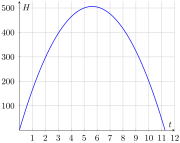
  2. The rocket travels vertically upwards, reaches its maximum height, and then falls back to the ground. It hits the ground at the time \(t\) when its height above the ground is zero; that is, when \(H(t) = 0\text{.}\) To find such \(t\text{,}\) we must solve the equation
    \begin{equation*} H(t) = -16 t^2 + 180 t=0 . \end{equation*}
    Note that the solutions to this equation are the horizontal intercepts of the quadratic parabola associated with \(H(t)\text{.}\) Factoring the left-hand side of the equation results in \(t ( -16 t + 180 ) = 0\text{,}\) or, equivalently,
    \begin{equation*} -16 t ( t - 11.25 )=0. \end{equation*}
    The horizontal intercepts are thus \(t=0\) and \(t=11.25\text{.}\) So the height of the rocket is 0 feet above the ground at both time \(t = 0\) β€” that is, at the moment of launch β€” and also at time \(t = 11.25\text{,}\) which is when the rocket comes back and hits the ground. Hence, the rocket hits the ground 11.25 seconds after launch.
  3. The rocket reaches its maximum height when \(H(t)\) is at its maximum. The graph of \(H(t) = -16 t^2 + 180 t\) is a parabola opening down. Hence, \(H(t)\) is at its maximum at the vertex of the parabola. Remember that the \(t\)-coordinate of the vertex is the midpoint of the horizontal intercepts, \(t_1 = 0\) and \(t_2 = 11.25\text{.}\) Hence, the \(t\)-coordinate of the vertex is \(\frac{t_1+t_2}{2}=\frac{0 + 11.25}{2} = 5.75\text{.}\) Thus, the maximum height is reached at time \(t = 5.75\text{.}\) The height at \(t = 5.75\) is
    \begin{equation*} H(5.75) = -16(5.75)^2 + 180(5.75) = 506 \end{equation*}
    feet. So at its highest, the rocket reaches 506 feet. The graph of the function \(H(t)\) explains everything:
    A short description.
    Note that the graph shows the height of the rocket \(H(t)\) as a function of time \(t\text{.}\) It does not show the path of the rocket, which travels straight up and down along a vertical line.

Exercises Exercises

Finding Intercepts.

Find the intercepts of each quadratic function.
6.
\(f(t)=64t^2-36\)
Solution.
horizontal intercepts: \(-\frac{3}{4}\text{,}\) \(\frac{3}{4}\text{;}\) vertical intercept: \(-36\)
10.
\(g(x)=\frac{1}{49}-4x^2\)
Solution.
horizontal intercepts: \(-\frac{1}{14}\text{,}\) \(\frac{1}{14}\text{;}\) vertical intercept: \(\frac{1}{49}\)

13.

A model rocket is launched vertically from the ground with an initial velocity of \(168\) feet per second. Let \(H(t)\) be the height, in feet, of the rocket \(t\) seconds after launch.
  1. Write a formula for the function \(H(t)\text{.}\)
  2. Find \(t\) when the model rocket hits the ground.
  3. Find the maximum height that the model rocket reaches.
Solution.
  1. \(\displaystyle H(t)=-16t^2+168t\)
  2. \(10.5\) seconds
  3. The maximum height that the model rocket reaches is \(441\) feet.

