Skip to main content
Contents Index Embed Dark Mode Prev Up Next \( \newcommand{\N}{\mathbb N}
\newcommand{\Z}{\mathbb Z}
\newcommand{\Q}{\mathbb Q}
\newcommand{\R}{\mathbb R}
\usepackage{xcolor,color}
\newcommand{\aroc}{\text{ARC}}
\newcommand{\pbr}[1]{\left( #1 \right)}
\newcommand{\sbr}[1]{\left\{ #1 \right\}}
\newcommand{\cbr}[1]{\left[ #1 \right]}
\newcommand{\abs}[1]{\left\lvert #1 \right\rvert}
\newcommand{\markcell}[2]{
\tikz[remember picture, baseline=(#1.base)] \node[inner sep=0pt] (#1) {#2};
}
\newcommand{\lt}{<}
\newcommand{\gt}{>}
\newcommand{\amp}{&}
\definecolor{fillinmathshade}{gray}{0.9}
\newcommand{\fillinmath}[1]{\mathchoice{\colorbox{fillinmathshade}{$\displaystyle \phantom{\,#1\,}$}}{\colorbox{fillinmathshade}{$\textstyle \phantom{\,#1\,}$}}{\colorbox{fillinmathshade}{$\scriptstyle \phantom{\,#1\,}$}}{\colorbox{fillinmathshade}{$\scriptscriptstyle\phantom{\,#1\,}$}}}
\)
Appendix A Selected Solutions
1 Introduction to Functions 1.1 The Concept of a Function Practice Problems
Solution .
The independent variable is
\(t\) and has units of years. The dependent variable is
\(V\) and has units of dollars.
Exercises
Solution .
The amount of caffeine in a person’s body \(0\) hours after drinking a cup of coffee is 96 mg.
The amount of caffeine in a person’s body \(5\) hours after drinking a cup of coffee is 48 mg.
The amount of caffeine in a person’s body
\(24\) hours after drinking a cup of coffee is approximately 0 mg.
Solution .
A total of 10 units of the product are produced in 1 hour.
A total of 0 units of the product are produced in 0 hours.
A total of approximately 29 units of the product are produced in 3 hours.
Solution .
\(p\text{;}\) dollars
\(C\text{;}\) dollars
\(\displaystyle \$30\)
Solution .
The independent variable is \(t\text{,}\) which represents the time spent baking in hours.
The dependent variable is
\(B\text{,}\) which represents the number of batches of cookies made by the bakery after
\(t\) hours have passed.
\(f(3)=18\text{;}\) The bakery makes 18 batches of cookies (or approximately 216 cookies) in 3 hours.
Solution .
The amount of fuel left in the fuel tank 70 miles into the drive is 6 gallons.
The amount of fuel left in the fuel tank 200 miles into the drive is 1 gallon.
Solution .
\(\displaystyle -9b+4\)
\(\displaystyle -3b+1\)
\(\displaystyle -3b\)
Solution .
\(\displaystyle 2\)
\(\displaystyle -10\)
\(\displaystyle 3\sqrt{2}-2\)
Solution .
\(\displaystyle h^2-2h+4\)
\(\displaystyle h^2+2h+4\)
\(\displaystyle b^2+2b\)
Solution .
\(\displaystyle 1\)
undefined
\(\displaystyle -1\)
Solution .
\(\displaystyle \frac{3}{h+1}\)
\(\displaystyle \frac{3}{h+3}\)
\(\displaystyle \frac{3}{b+2}-4\)
Solution .
\(\displaystyle \frac{9}{2}\)
\(\displaystyle h^2+2h+1+\frac{1}{h+1}\)
\(\displaystyle h^2+2h+\frac{1}{h+1}-\frac{7}{2}\)
Solution .
\(\displaystyle \frac{17}{2}\)
\(\displaystyle 2x+\frac{23}{2}\)
\(\displaystyle -2x^2-\frac{31}{2}x-35\)
Solution .
\(\displaystyle \$45\)
\(4.5\) hours
Solution .
\(\displaystyle \$16500\)
\(\displaystyle \$9000\)
\(11\) years
Solution .
\(S\) is the independent variable; \(D\) is the dependent variable
\(\frac{4}{5}\) of a mile
Solution .
\(\displaystyle 7x+5\)
\(\displaystyle 7(x+5)\)
Solution .
\(\displaystyle 5x^2-8\)
\(\displaystyle (5x)^2-8 = 25x^2-8\)
\(\displaystyle 5(x-8)^2\)
Solution .
\(\displaystyle \frac{x}{3} + \sqrt{x}\cdot 4\)
\(\displaystyle \frac{1}{\sqrt{x}}+1+x^2\)
Solution .
all real numbers or \((-\infty,\infty)\) in interval notation
all real numbers \(x\neq1\) or \((-\infty,1)\cup(1,\infty)\) in interval notation
all real numbers \(x\neq-2\text{,}\) \(x\neq2\) or \((-\infty,-2)\cup(-2,2)\cup(2,\infty)\) in interval notation
all real numbers \(x\geq0\) or \([0,\infty)\) in interval notation
all real numbers or \((-\infty,\infty)\) in interval notation
Solution .
all real numbers or \((-\infty,\infty)\) in interval notation
all real numbers \(x\neq0\) or \((-\infty,0)\cup(0,\infty)\) in interval notation
all real numbers \(x\gt 0\) or \((0,\infty)\) in interval notation
1.2 The Graph of a Function Exercises
Solution .
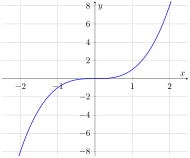
\(x\) \(-2\) \(-1\) \(0\) \(1\) \(2\)
\(y\) \(-8\) \(-1\) \(0\) \(1\) \(8\)
Solution .
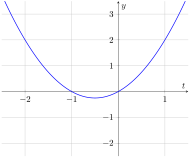
\(t\) \(-2\) \(-1\) \(0\) \(1\)
\(f(t)\) \(2\) \(0\) \(0\) \(2\)
Solution .
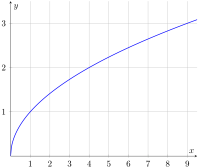
\(x\) \(0\) \(1\) \(4\) \(9\)
\(g(x)\) \(0\) \(1\) \(2\) \(3\)
Solution .
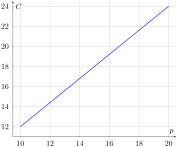
\(p\) \(10\) \(12\) \(14\) \(16\) \(18\) \(20\)
\(C\) \(12\) \(14.4\) \(16.8\) \(19.2\) \(21.6\) \(24\)
Solution .
\(\displaystyle f(2) = -8\)
\(\displaystyle f(3) = -10\)
\(\displaystyle f(-1) = 10\)
Solution .
\(x=-2\text{,}\) \(x=1\text{,}\) and
\(x=4\text{.}\)
Solution .
\(x\approx -1.5\text{,}\) \(x=0\text{,}\) and
\(x\approx 4.5\text{.}\)
Solution .
\(\displaystyle f(0)=9\)
\(\displaystyle f(12)=9\)
\(\displaystyle f(10)\approx 10.5\)
Solution .
\(t=3\text{,}\) \(t=9\text{,}\) \(t=15\text{,}\) and
\(t=21\)
Solution .
\(13.2\) gallons.
\(8\) gallons.
The gas tank is empty.
Approximately \(40\) miles per gallon.
Solution .
\(96\) mg.
After \(5\) hours, there are \(48\) mg left. After \(10\) hours, \(24\) mg.
Decreasing.
Solution .
\(\$1000\text{.}\)
After 10 years, \(\$2000\text{.}\) After 20 years, \(\$4000\text{.}\)
Increasing.
Solution .
No, because it fails the vertical line test (in many places!).
Solution .
\(f(0) = -4\text{.}\)
\(x=-2\) and \(x=2\text{.}\)
\(x=-3\) and \(x = 3\text{.}\)
Solution .
Increasing on the intervals
\((0,3) \cup (9,12)\text{.}\) Or, write as \(0\lt t\lt 3\) and \(9\lt t\lt 12\) . Decreasing on the interval
\((3,9)\text{.}\) Or, write as \(3\lt t \lt 9\) .
1.3 Functions Given Numerically
Exercises
Solution .
\(\displaystyle 2.23\)
\(\displaystyle 3.87\)
\(\displaystyle 4.47\)
Solution .
\(\displaystyle x=0\)
\(\displaystyle x=5\)
Solution .
\(\displaystyle g(4)=1.5\)
\(\displaystyle g(2)=3.7\)
\(\displaystyle g(8)=1.5\)
Solution .
\(t=0\text{,}\) \(t=4\text{,}\) and \(t=8\)
\(\displaystyle t=2\)
Solution .
\(t\) \(5\) \(6\)
\(F(t)\) \(-10\) \(-12\)
Solution .
\(d\) \(180\) \(216\) \(252\)
\(G(d)\) \(11\) \(9.5\) \(8\)
The gas mileage of the driver’s Volkswagen Passat is 24 miles per gallon.
Solution .
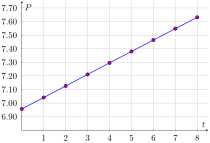
\(t\) \(0\) \(1\) \(2\) \(3\) \(4\) \(5\) \(6\) \(7\) \(8\)
\(P(t)\) \(6.957\) \(7.041\) \(7.126\) \(7.211\) \(7.296\) \(7.380\) \(7.464\) \(7.548\) \(7.631\)
Solution .
The amount of power required for the dragon to carry the knight is increasing as the dragon’s speed increases. This is evident from the table since the values associated with the power required increase as the speed increases.
The amount of power required for the dragon to carry the knight is increasing faster and faster as the dragon’s speed increases. This is evident from the table since each time the speed increases by 10 miles per hour starting at 60 miles per hour, the power required to carry the knight increases by more and more.
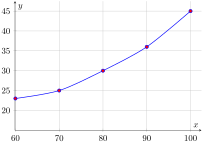
Solution .
The amount of power required for the dragon to carry the knight is increasing as the dragon’s speed increases. This is evident from the graph since it climbs over the interval
\(60\leq x \leq 100\text{.}\)
The amount of power required for the dragon to carry the knight is increasing faster and faster as the dragon’s speed increases. This is evident from the graph since each time the speed increases by 10 miles per hour starting at 60 miles per hour, the graph climbs more and more quickly.
1.4 Vertical and Horizontal Intercepts
Exercises
Solution .
horizontal intercept: \(0.5\text{;}\) vertical intercept: \(-1.5\)
horizontal intercepts: \(-1\text{,}\) \(1\text{;}\) vertical intercept: \(1\)
horizontal intercept: \(27\text{;}\) vertical intercept: \(5.4\)
horizontal intercept: \(-2\text{;}\) vertical intercept: \(16\)
horizontal intercept: \(9/4\text{;}\) vertical intercept: \(-3\)
horizontal intercepts: none; vertical intercept: none
horizontal intercept: none; vertical intercept: \(-1\)
Solution .
horizontal intercepts: \(-1\text{,}\) 2; vertical intercept: 2
horizontal intercepts: none; vertical intercept: 5
horizontal intercept: 8; vertical intercept: none
Solution .
horizontal intercepts: 0, 4, 8; vertical intercept: 0
horizontal intercepts: none; vertical intercept: 3
Solution .
vertical intercept: 300—this is the number of feet above the lake that the ball is dropped from;
horizontal intercept: \(t \approx 4.33\) —this is the number of seconds that it takes after being dropped for the ball to hit the surface of the lake
Solution .
vertical intercept: 21500—this is the price in dollars for which the car was purchased;
horizontal intercept: \(t \approx 14.33\) —this is the number of years after purchase that it takes for the car’s value to depreciate to
\(\$0\)
1.5 The Average Rate of Change
Exercises
Solution .
\(\displaystyle 6\)
\(\displaystyle -3\)
\(\displaystyle -1/3\)
\(\displaystyle -3\)
\(\displaystyle -3\)
Solution .
\(0.0845\) billion people per year; \(0.0835\) billion people per year
No.
Solution .
\(-48\) feet per second; \(-80\) feet per second
negative; the height of the ball is decreasing as time progresses (as it was dropped)
Solution .
\(-9.6\) mg/hr
\(-2.4\) mg/hr
The average rate of change from
\(t = 0\) to
\(t = 5\) hours is larger than the average rate of change from
\(t=10\) to
\(t=15\) hours. It can be seen that the rate at which the amount of caffeine in the bloodstream is changing gets smaller and smaller as time progresses.
Solution .
positive since the graph is increasing on this interval
negative since the graph is decreasing on this interval
Solution .
\(-0.325\) pounds/minute
\(-0.035\) pounds/minute
The rate of weight loss slows as the daily amount of exercise increases.
Solution .
approximately 2.124 million cars sold per year
\(-3.175\) million cars sold per year
from 2017 to 2018 and from 2018 to 2019
2 Linear Functions 2.1 Properties of Linear Functions Exercises
Solution .
\(f(x)=3x-6\text{;}\) slope: 3; vertical intercept:
\(-6\)
Solution .
\(g(x)=8x-2\text{;}\) slope:
\(8\text{;}\) vertical intercept:
\(-2\)
Solution .
\(h(t)=9t-2.5\text{;}\) slope:
\(9\text{;}\) vertical intercept:
\(-2.5\)
Solution .
\(m(x)=2x\text{;}\) slope:
\(2\text{;}\) vertical intercept:
\(0\)
Solution .
\(-\frac{4}{3}\approx-1.33\)
Solution .
slope: \(0.5\text{;}\) vertical intercept: \(1\text{;}\) equation: \(y=0.5x+1\)
slope: \(-\frac{3}{2}\text{;}\) vertical intercept: \(-1\text{;}\) equation: \(y=-\frac{3}{2}x-1\)
slope: \(\frac{2}{3}\text{;}\) vertical intercept: \(0\text{;}\) equation: \(y=\frac{2}{3}x\)
slope: \(-\frac{2}{3}\text{;}\) vertical intercept: \(-1\text{;}\) equation: \(y=-\frac{2}{3}x-1\)
Solution .
Line 1 is
\(y=3x+2\text{;}\) Line 2 is
\(y=3x-1\text{;}\) Line 3 is
\(y = 2\text{;}\) Line 4 is
\(y=x-1\text{;}\) Line 5 is
\(y=-2x-3\text{.}\)
Solution .
The initial elevation of the hiker is 1350 feet.
The hiker’s elevation is increasing at a rate of 35 feet per minute.
Solution .
The bicyclist’s initial distance from the finish line is 50 miles.
The bicyclist’s distance from the finish line is decreasing at a rate of 25 miles per hour.
2.2 Working with Linear Functions and Linear Equations Exercises
Solution .
\(y=-\frac{1}{2}x-\frac{4}{5}\)
Solution .
\(f(x)=-\frac{3}{2}x-\frac{1}{2}\)
Solution .
\(f(x)=\frac{5}{6}x+\frac{23}{6}\)
Solution .
(c) is not the graph of a linear function.
Solution .
The vertical intercept 60 is the distance in miles that the biker is from the finish line at the start of the race.
The horizontal intercept 3 is the number of hours that it takes the biker to complete the race.
The slope
\(-20\) indicates that the distance between the biker and the finish line is decreasing at a rate of 20 miles per hour.
Solution .
\(\displaystyle \$1900\)
The lamp will have a value of 4000 dollars 8.4 years after its purchase.
Solution .
\(A(m)=0.20m+75\text{;}\) \(B(m)=0.10m+90\)
\(\displaystyle m=150\)
\(\displaystyle B(m)\)
Solution .
infinite number of solutions
2.3 Modeling and Numerically Given Functions
Exercises
Solution .
linear with equation \(y=-3.3x+12.6\)
linear with equation \(f(t)=0.15t+0.25\)
not linear
not linear
linear with equation \(w(z)=-0.4z+5.2\)
Solution .
approximately linear with approximate equation
\(C=0.555F-17.76\)
Solution .
\(\displaystyle H=2.32L+65.53\)
\(172.25\) cm
approximately 47.36 cm
Solution .
\(\displaystyle P=0.4d+14.7\)
\(66.7\) PSI
Solution .
\(\displaystyle T(h)=-0.00356h+65\)
\(42.89\) \(^\circ\) F
The function \(T(h)\) is decreasing.
Solution .
Linear; formula \(H(t)=\frac{2}{3}t+85\)
The slope is
\(\frac{2}{3}\) bpm per minute; the practical meaning of the slope is that the man’s bpm is increasing at a rate of
\(\frac{2}{3}\) bpm per minute. The vertical intercept is
\(85\) bpm; the practical meaning of the vertical intercept is that the man’s resting heart rate (heart rate when performing no exercise on the treadmill) is
\(85\) bpm.
3 Quadratic Functions 3.1 Introduction to Quadratic Functions Exercises
Solution .
\(f(x)=4x^2-7x\text{;}\) opens up
Solution .
\(h(t)=-5t^2+21\text{;}\) opens down
Solution .
\(g(x)=2x^2-14x\text{;}\) opens up
Solution .
\(y=-4x^2-40x-20\text{;}\) opens down
Solution .
horizontal intercepts:
\(-1\text{,}\) \(3\text{;}\) vertical intercept:
\(-3\text{;}\) vertex:
\((1,-4)\)
Solution .
no horizontal intercepts; vertical intercept:
\(-2\text{;}\) vertex:
\((1,-1)\)
Solution .
\((6,0)\text{;}\) opens down
Solution .
\(R(p)=p(1000-2p)\) or \(R(p)=-2p^2+1000p\)
\(\displaystyle \$500\)
The maximum revenue is
\(\$125,000\text{.}\) The lighting company should charge
\(\$250\) per specialty chandelier to maximize revenue.
3.2 Factoring Quadratic Expressions Exercises
Solution .
horizontal intercepts:
\(-1\text{,}\) \(-2\text{;}\) vertical intercept:
\(2\)
Solution .
horizontal intercepts:
\(-2\text{,}\) \(3\) ; vertical intercept:
\(-6\)
Solution .
horizontal intercepts:
\(-3\text{,}\) \(2\) ; vertical intercept:
\(-6\)
Solution .
horizontal intercepts:
\(4\text{;}\) vertical intercept:
\(16\)
Solution .
horizontal intercept:
\(-7\text{;}\) vertical intercept:
\(49\)
Solution .
horizontal intercepts:
\(-\frac{3}{4}\text{,}\) \(\frac{3}{4}\text{;}\) vertical intercept:
\(-36\)
Solution .
horizontal intercepts:
\(-4\text{,}\) \(-1\text{;}\) vertical intercept:
\(8\)
Solution .
horizontal intercepts:
\(-1\text{,}\) \(\frac{3}{2}\text{;}\) vertical intercept:
\(-3\)
Solution .
horizontal intercepts:
\(-8\text{,}\) \(2\text{;}\) vertical intercept:
\(16\)
Solution .
horizontal intercepts:
\(-\frac{1}{14}\text{,}\) \(\frac{1}{14}\text{;}\) vertical intercept:
\(\frac{1}{49}\)
Solution .
horizontal intercepts:
\(0\text{,}\) \(3\text{;}\) vertical intercept:
\(0\)
Solution .
horizontal intercepts:
\(0\text{,}\) \(\frac{2}{5}\text{;}\) vertical intercept:
\(0\)
Solution .
\(\displaystyle H(t)=-16t^2+168t\)
\(10.5\) seconds
The maximum height that the model rocket reaches is \(441\) feet.
3.3 Vertex Form and Completing the Square Exercises
Solution .
\(\left(-\frac{1}{2},\frac{5}{3}\right)\)
Solution .
\(f(x)=x^2+2x+3\text{;}\) \(a=1\text{,}\) \(b=2\text{,}\) \(c=3\)
Solution .
\(g(x)=5x^2-20x+26\text{;}\) \(a=5\text{,}\) \(b=-20\text{,}\) \(c=26\)
Solution .
\(y=-2t^2+16t-27\text{;}\) \(a=-2\text{,}\) \(b=16\text{,}\) \(c=-27\)
Solution .
\(h(x)=-x^2-x+\frac{17}{12}\text{;}\) \(a=-1\text{,}\) \(b=-1\text{,}\) \(c=\frac{17}{12}\)
Solution .
\(f(x)=(x+1)^2-6\text{;}\) vertex:
\((-1,-6)\)
Solution .
\(g(x)=\left(x-3\right)^2+1\text{;}\) vertex
\((3,1)\)
Solution .
\(h(x)=\left(x+\frac{3}{2}\right)^2-1\text{;}\) vertex
\(\left(-\frac{3}{2},-1\right)\)
Solution .
\(F(x)=-\left(x-5\right)^2+40\text{;}\) vertex
\((5,40)\)
Solution .
\(G(x)=-3(x-1)^2-1\text{;}\) vertex
\((1,-1)\)
Solution .
\(H(x)=-2\left(x+4\right)^2+15\text{;}\) vertex
\((-4,15)\)
Solution .
\(1-\sqrt{2}\approx-0.414\text{,}\) \(1+\sqrt{2}\approx2.414\)
Solution .
\(-2-\sqrt{10}\approx-5.162\text{,}\) \(-2+\sqrt{10}\approx1.162\)
Solution .
\(-4-\sqrt{\frac{5}{2}}\approx-5.581\text{,}\) \(-4+\sqrt{\frac{5}{2}}\approx-2.419\)
3.4 The Quadratic Formula Exercises
Solution .
\(x=-\frac{1}{2}=-0.5\) and
\(x=\frac{1}{3}\approx0.333\)
Solution .
\(x=1-\sqrt{3}\approx-0.732\) and
\(x=1+\sqrt{3}\approx2.732\)
Solution .
\(x=-3\) and
\(x=-\frac{5}{4}=-1.25\)
Solution .
\(x=\dfrac{1-\sqrt{41}}{2}\approx-2.701\) and
\(x=\dfrac{1+\sqrt{41}}{2}\approx3.702\)
Solution .
horizontal intercepts:
\(-3\text{,}\) \(1\text{;}\) vertical intercept:
\(-3\text{;}\) vertex:
\((-1,-4)\)
Solution .
horizontal intercepts:
\(-4-\sqrt{6}\approx-6.450\text{,}\) \(-4+\sqrt{6}\approx-1.551\text{;}\) vertical intercept:
\(10\text{;}\) vertex:
\((-4,-6)\)
Solution .
horizontal intercepts:
\(\frac{3-2\sqrt{3}}{3}\approx-0.155\text{,}\) \(\frac{3+2\sqrt{3}}{3}\approx2.155\text{;}\) vertical intercept:
\(-1\text{;}\) vertex:
\((1,-4)\)
Solution .
no horizontal intercepts; vertical intercept: 5; vertex
\((2,1)\)
Solution .
132; two distinct real solutions
Solution .
\(-116\text{;}\) no real solutions
Solution .
56; two distinct real solutions
Solution .
\(\displaystyle H(t)=-16t^2+50t+6\)
The ball reaches its maximum height approximately 1.56 seconds after it is thrown straight up and that maximum height is approximately 45.06 feet.
Solution .
\(g(x)=\left(x-(-3-\sqrt{2})\right)\left(x-(-3+\sqrt{2})\right)\)
Solution .
\(f(x)=-2(x+1)(x-2)\text{;}\) \(f(x)=-2x^2+2x+4\)
Solution .
\(g(t)=(t-2)(t+2)\text{;}\) \(g(t)=t^2-4\)
4 Power Functions 4.1 Algebra of Powers: Integral Exponents
Exercises
Solution .
\begin{align*}
(a^p)^r \amp = \left( \underbrace{a \cdot a \cdot \ldots \cdot a}_{p \text{ times}}\right)^r\\
\amp = \underbrace{\left( \underbrace{a \cdot a \cdot \ldots \cdot a}_{p \text{ times}}\right) \cdot \ldots \cdot \left( \underbrace{a \cdot a \cdot \ldots \cdot a}_{p \text{ times}}\right)}_{r \text{ times}}\\
\amp= \underbrace{a \cdot a \cdot \ldots \cdot a}_{p \cdot r \text{ times}}\\
\amp= a^{p\cdot r}
\end{align*}
4.2 Algebra of Powers: Fractional Exponents Exercises
Solution .
\(x=-\sqrt[4]{20}\approx-2.115\) and
\(x=\sqrt[4]{20}\approx2.115\)
Solution .
\(b=-\sqrt[30]{\frac{34}{3}} \approx -1.084\) and
\(b=\sqrt[30]{\frac{34}{3}} \approx 1.084\)
Solution .
\(x=\sqrt[3]{-\frac{2}{5}}\approx-0.737\)
Solution .
\(x=1-\sqrt{3}\approx-0.732\) and
\(x=1+\sqrt{3}\approx2.732\)
Solution .
\(\dfrac{y^2}{\sqrt[3]{x}}\)
4.3 Power Functions: Positive Integral Exponents Exercises
Solution .
\(y=4x^3\text{;}\) \(k=4\text{;}\) \(p=3\)
Solution .
\(y=3x^3\text{;}\) \(k=3\text{;}\) \(p=3\)
Solution .
\(y=0.1x^3\text{;}\) \(k=0.1\text{;}\) \(p=3\)
Solution .
\(y=9x^2\text{;}\) \(k=9\text{;}\) \(p=2\)
Solution .
Yes;
\(k=\frac{0.034}{\mu}\text{;}\) \(p=2\)
Solution .
\(59.5\) feet;
\(238\) feet
Solution .
\(p\) is even and \(k\) is positive.
\(p\) is odd and \(k\) is positive.
\(p\) is odd and \(k\) is negative.
\(p\) is even and \(k\) is negative.
Solution .
A is
\(y=x^4\text{;}\) B is
\(y=-x^4\text{;}\) C is
\(y=\frac{1}{4}^4\text{.}\)
4.4 Power Functions: Fractional and Negative Integral Exponents Exercises
Solution .
\(y=10x^{1/2}\text{;}\) \(k=10\text{;}\) \(p=\frac{1}{2}\)
Solution .
\(y=0.1x\text{;}\) \(k=0.1\text{;}\) \(p=1\)
Solution .
\(y=\frac{1}{4}x^{17/12}\text{;}\) \(k=\frac{1}{4}\text{;}\) \(p=\frac{17}{12}\)
Solution .
\(y=\frac{1}{3}x^2\text{;}\) \(k=\frac{1}{3}\text{;}\) \(p=2\)
Solution .
\(p\) is odd; \(k\) is positive.
\(p\) is even; \(k\) is negative.
\(p\) is odd; \(k\) is negative.
\(p\) is even; \(k\) is positive.
Solution .
Graph A is
\(y=2 x^{1/2}\text{,}\) graph B is
\(y=x^{1/2}\text{,}\) and graph C is
\(y=-x^{1/2}\text{.}\)
Solution .
yes;
\(T=\dfrac{2\pi}{\sqrt{g}}L^\frac{1}{2}\) where the coefficient is
\(\dfrac{2\pi}{\sqrt{g}}\) and the exponent is
\(\frac{1}{2}\text{.}\)
approximately \(1.42\) seconds.
approximately \(0.47 \text{ m}/\text{sec}^2\text{.}\)