A function \(y = f(x)\) is called a power function if \(f(x)\) can be expressed in the form:
\begin{equation*}
f(x) = kx^p
\end{equation*}
where \(k\) and \(p\) are constants and \(k \neq 0\text{.}\) The constant \(k\) is called the coefficient of the power function \(f(x)\) and \(p\) is called the exponent.
Note: When \(y\) depends on \(x\) according to the formula \(y = kx^p\) we say that \(y\) is directly proportional (or proportional) to \(x^p\) with the coefficient of proportionality \(k\) If \(\displaystyle y = \frac{k}{x^p}\text{,}\) we say that \(y\) is inversely proportional to \(x^p\) with the coefficient of proportionality \(k\text{.}\) So power functions express proportionality of the dependent variable to powers of the independent variable.
Which of the functions below are power functions? For those which are, rewrite in the standard form \(y = kx^p\text{.}\) Identify the coefficient and the exponent.
The function \(r(x)\) is not a power function. It cannot be rewritten as \(r(x) = kx^p\text{.}\) The function \(r(x)\) is a sum of two power functions, \(2x^3\) and \(7x^2\text{.}\) A function that is a sum of power functions is called a polynomial function.
\(l(x)\) is not a power function. Observe that in \(l(x)\) the base of the power expression \(2^x\) is constant and equal to 2. The exponent \(x\) is a variable. In a power function, it is the other way around: the base is a variable and the exponent is constant.
Note that in terms of proportionality, we can say that the distance \(d\) is directly proportional to \(t^2\) with the coefficient of proportionality \(16\text{.}\)
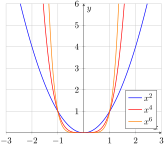
If \(p\) is even, then \(x^p\) is positive for all \(x\) except for \(x = 0\) where \(x^p = 0\text{.}\) For example, if \(p=6\) then \(1^6 = 1\text{,}\)\((-1)^6 = 1\text{,}\)\(2^6 = 64\text{,}\)\((-2)^6 = 64\text{,}\) and so on. Hence, the graph of the power function \(f(x) = kx^p\) for any even \(p\) is symmetric about the \(y\)-axis as \(f(-x) = f(x)\text{.}\)
Here are the graphs of the functions \(y = kx^p\) for \(p = 2, 4, 6\) and \(k = 1\text{.}\) All graphs are U-shaped and reminiscent of the quadratic parabola \(y = x^2\text{.}\)
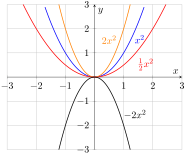
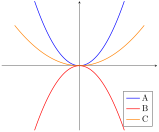
The coefficient \(k\) in \(y = kx^p\text{,}\) stretches or shrinks the graph of \(y = x^p\) vertically. Additionally, if \(k \lt 0\text{,}\) the graph is reflected over the \(x\)-axis.
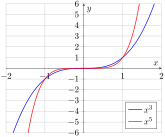
If \(p\) is odd, then \(x^p\) is positive for \(x \gt 0\text{,}\) it is \(0\) for \(x = 0\text{,}\) and negative for \(x \lt 0\text{.}\) For example, let \(p=3\text{.}\) Then \(1^3 = 1\text{,}\)\((-1)^3 = -1\text{,}\)\(2^3 = 8\text{,}\)\((-2)^3 = -8\text{,}\) and so on. Hence, the graph of the power function \(f(x) = kx^p\) for any odd \(p\) is symmetric about the origin \((0, 0)\) as \(f(-x) = -f(x)\text{.}\)
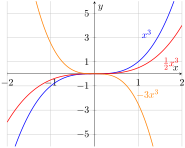
The coefficient \(k\) in \(y = kx^p\text{,}\) stretches or shrinks the graph of \(y = x^p\) vertically. Additionally, if \(k \lt 0\text{,}\) the graph is reflected over the \(x\)-axis.
Here is a summary of how graphs of power functions look for positive integer exponents \(p\text{,}\) even and odd, and for coefficients \(k\) positive and negative.
“Braking distance” or “stopping distance” refers to the distance a car will travel from the point when its brakes are fully applied to when it comes to a complete stop 1
. The braking distance is proportional to the square of the car’s speed and it depends on the coefficient of friction, \(\mu\text{,}\) between the tires and the road surface. Let \(D\) denote distance, in feet, and \(S\) speed in mph. The formula for the braking distance is:
Is the braking distance a power function of speed? If yes, give the coefficient \(k\) and the exponent \(p\text{.}\) Assume that \(\mu\) is a given constant.
The coefficient of friction under normal conditions when the road is dry is \(\mu=0.7\text{.}\) What is the braking distance of a car that travels on a dry road at \(35\) mph? What is the braking distance at \(70\) mph?
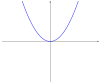
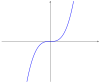
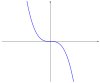
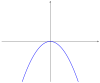
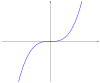
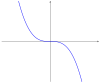
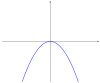
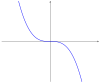
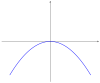
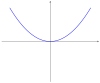
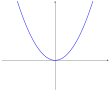
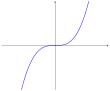
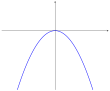
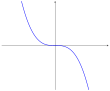
Below are the graphs of four power functions \(y=kx^p\) where \(p\) is a positive integer. In each of the graphs, is the exponent \(p\) even or odd? Is the coefficient \(k\) positive or negative?
Find the side length \(a\text{,}\) in cm, which gives the area \(A\) equal to \(8 \text{ cm}^2\text{.}\) Round off your answer to three decimal places.