Applied Precalculus MTH 103

Section 1.4 Vertical and Horizontal Intercepts

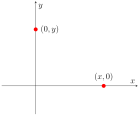
The points where the graph of a function crosses the horizontal axis or the vertical axis are of special interest. They are called the horizontal and the vertical intercepts. If the independent variable is named \(x\) and the dependent variable is named \(y\text{,}\) the horizontal and vertical intercepts are also called \(x\)-intercepts and \(y\)-intercepts, respectively.
A short description.
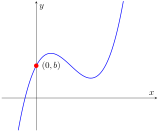
The plot above illustrates that every point in the \(xy\)-plane that lies on the \(y\)-axis has the \(x\)-coordinate \(0\text{,}\) and every point that lies on \(x\)-axis has the \(y\)-coordinate \(0\text{.}\) We will use this observation to find the vertical and horizontal intercepts (if they exist).

Definition 1.4.1. Vertical Intercept.

Suppose the graph of the function \(y=f(x)\) crosses the \(y\)-axis at \(y=b\text{;}\) that is, at the point \((0,b)\text{.}\) Then \(b\) is called the \(y\)-intercept of the function \(f\text{.}\)
Since \((0,b)\) is on the graph of the function, \(b=f(0)\text{.}\) So the \(y\)-intercept is simply the value of the function at \(x=0\text{.}\)

By the way...

If \(x=0\) is in the domain of \(f\text{,}\) we have exactly one \(y\)-intercept. If \(x=0\) is not in the domain, the graph of \(f\) does not cross the \(y\)-axis and there is no \(y\)-intercept.
That is: To find the vertical intercept of \(f(x)\text{,}\) evaluate \(f(0)\).
A short description.

Definition 1.4.2. Horizontal Intercepts.

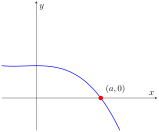
Suppose that the graph of the function \(y=f(x)\) crosses the \(x\)-axis at \(x=a\text{;}\) that is, at the point \((a,0)\text{.}\) Then \(a\) is called an \(x\)-intercept of the function \(f\text{.}\)
Since the point \((a,0)\) is on the graph of the function, \(f(a)=0\text{.}\) So the \(x\)-intercepts are the real values of \(x\) at which \(f(x)=0\text{.}\) A function may have many \(x\)-intercepts. They are often called the zeros or roots of a graphed function \(f\text{.}\)
That is: To find horizontal intercepts of \(f(x)\text{,}\) solve \(f(x)=0\) for \(x\text{.}\)
A short description.

Example 1.4.3.

Consider the function \(y=f(x)\) where \(f(x)=x^{2}-4\text{.}\) Find the vertical intercept and the horizontal intercepts.
Solution.
To find the \(y\)-intercept, we evaluate \(f(0)=0^{2}-4=-4\text{.}\) Therefore, \(f(x)\) crosses the \(y\)-axis at \(y=-4\text{;}\) that is, the vertical intercept is the point \((0,-4)\text{.}\)

By the way...

To find \(x\)-intercepts, we have to solve the equation \(f(x)=0\text{.}\) For our function, the equation we must solve is \(x^{2}-4=0\text{.}\) We use the standard techniques for solving equations.
\begin{align*} x^{2}-4 \amp \;=\; 0\\ x^{2} \amp \;=\; 4\\ x \amp \;=\; \pm\sqrt{4}\\ x \amp \;=\; \pm \, 2 \end{align*}
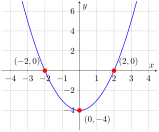
There are two solutions, \(x=-2\) and \(x=2\text{.}\) These are the two horizontal intercepts or zeros of the function. Since \(f(-2)=0\) and \(f(2)=0\text{,}\) the associated ordered pairs are \((-2,0)\) and \((2,0)\text{.}\)

By the way...

The graph of the function clearly shows the intercepts and the corresponding points on the \(xy\)-plane:
A short description.

Example 1.4.4.

A full tank of water springs a leak. Water is leaking out at the rate of \(3\) gallons per hour. Let \(A=w(t)\) be the amount of water in the tank, in gallons, \(t\) hours after the leak started.The function \(w(t)\) is given by
\begin{equation*} A=w(t)=60-3t. \end{equation*}
Find vertical and horizontal intercepts of the function \(A=w(t)\) and interpret them in practical terms. Also graph the function.
Solution.
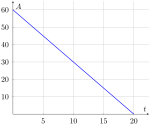
For the vertical interceptβ€”or the \(A\)-interceptβ€”of the function \(A=w(t)\text{,}\) we evaluate \(w(0)\text{,}\) which results in \(A=60\text{.}\) Since \(60\) is the value of \(A\) at \(t=0\text{,}\) it is measured in gallons and it gives the initial amount of water in the tank. We conclude that the vertical intercept of 60 gallons is the initial amount of water in the tank. Note that 60 gallons is also the capacity of the tank as the tank was full when the leak began at time \(t=0\text{.}\)
To find horizontal intercepts, we have to solve the equation \(w(t)=0\) for \(t\text{;}\) that is,
\begin{align*} 60-3t \amp \;=\; 0\\ 60 \amp \;=\; 3t\\ 20 \amp \;=\; t\\ t \amp \;=\; 20 \end{align*}
The function has one horizontal intercept at \(t=20\text{.}\) Thus, \(20\) hours after the leak started, the amount of water \(A(20)\) left in the tank is \(A=w(20)=0\text{.}\) In practical terms, it will take \(20\) hours until the tank is empty.
Here is the graph of the function \(A=w(t)\text{.}\) The intercepts are clearly visible on the graph and their meaning is clear as well.
A short description.
Given the graph of a function, with its formula unknown, we are still able to find the intercepts.

Example 1.4.5.

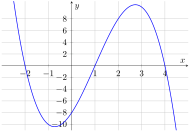
Use the graph of a function \(y=f(x)\) below to estimate its vertical and horizontal intercepts.
A short description.
Solution.
The vertical intercept is where the graph of a function crosses the vertical axis, which is the \(y\)-axis for the function shown. We can see that this is the ordered pair \((0,-8)\text{.}\) Thus, the vertical intercept occurs at \(y=-8\text{.}\)
The graph crosses the \(x\)-axis at each of \(x=-2,1,4\text{.}\) These are the \(x\)-intercepts (the zeros) of \(f(x)\text{,}\) meaning \(f(x)=0\) for each of \(x=-2,1,4\text{.}\) The corresponding points are \((-2,0)\text{,}\) \((1,0)\text{,}\) and \((4,0)\text{.}\)
Similarly, given a function \(y=f(x)\) that is described numerically (i.e., by a table of values), we can find the intercepts by looking for when \(y=0\) or \(x=0\text{.}\)

Example 1.4.6.

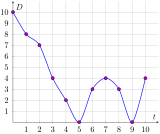
Every summer the depth of water in a reservoir is measured weekly over the 10-week period beginning with July 1. Let \(D\) be the depth of water, in meters, and \(t\) denote the time, in weeks, since July 1. Here, \(D\) is a function of \(t\text{,}\) which can be written as \(D=D(t)\text{.}\) The readings from 2019 are provided in the table below.
Table 1.4.7.
\(t\) (weeks) \(0\) \(1\) \(2\) \(3\) \(4\) \(5\) \(6\) \(7\) \(8\) \(9\) \(10\)
\(D(t)\) (meters) \(10\) \(8\) \(7\) \(4\) \(2\) \(0\) \(3\) \(4\) \(3\) \(0\) \(4\)
What are the vertical and horizontal intercepts given by the table? What is their practical meaning? Verify your answer on a graph of \(D(t)\text{.}\)
Solution.
The vertical intercept occurs when \(t=0\) and hence has value given by \(D(0)\text{.}\) Per the table, \(D(0)=10\text{.}\) Hence, the vertical intercept, or \(D\)-intercept, is \(10\text{.}\) In practical terms, the vertical intercept tells us that the water depth on July 1, 2019 was 10 meters.
The horizontal intercepts are values of \(t\) for which \(D(t)=0\text{.}\) The depth is \(0\) at \(t=5\) and \(t=9\text{.}\) In practical terms, the horizontal intercepts tell us that at both 5 and 9 weeks after July 1, 2019, the reservoir was empty. Below is a graph that fits the data from TableΒ 1.4.7. We can clearly see the intercepts.
A short description.

Exercises Exercises

1.

Find the horizontal and vertical intercepts or state that they don’t exist for each function given below.
  1. \(\displaystyle y=3x-1.5\)
  2. \(\displaystyle f(x)=1-x^2\)
  3. \(\displaystyle g(t)=5.4-0.2t\)
  4. \(\displaystyle y=2x^3+16\)
  5. \(\displaystyle h(m)=2\sqrt{m}-3\)
  6. \(\displaystyle y=\dfrac{1}{x}\)
  7. \(\displaystyle y=\dfrac{1}{x-1}\)
Solution.
  1. horizontal intercept: \(0.5\text{;}\) vertical intercept: \(-1.5\)
  2. horizontal intercepts: \(-1\text{,}\) \(1\text{;}\) vertical intercept: \(1\)
  3. horizontal intercept: \(27\text{;}\) vertical intercept: \(5.4\)
  4. horizontal intercept: \(-2\text{;}\) vertical intercept: \(16\)
  5. horizontal intercept: \(9/4\text{;}\) vertical intercept: \(-3\)
  6. horizontal intercepts: none; vertical intercept: none
  7. horizontal intercept: none; vertical intercept: \(-1\)

2.

Identify the horizontal and vertical intercepts for each function given numerically below.
  1. \(x\) \(-2\) \(-1\) \(0\) \(1\) \(2\) \(3\)
    \(y\) \(3\) \(0\) \(2\) \(2.5\) \(0\) \(4\)
  2. \(t\) \(0\) \(2\) \(4\) \(6\) \(8\) \(10\)
    \(f(t)\) \(5\) \(6\) \(8\) \(4\) \(8\) \(4\)
  3. \(x\) \(3\) \(4\) \(5\) \(6\) \(7\) \(8\)
    \(g(x)\) \(-5\) \(-4\) \(-5\) \(-2\) \(-2\) \(0\)
Solution.
  1. horizontal intercepts: \(-1\text{,}\) 2; vertical intercept: 2
  2. horizontal intercepts: none; vertical intercept: 5
  3. horizontal intercept: 8; vertical intercept: none

4.

A ball is dropped from a cliff above a lake. The ball’s height above the surface of the lake, \(h(t)\text{,}\) in feet, \(t\) seconds after the ball is dropped, is given by
\begin{equation*} h(t)=300-16t^2. \end{equation*}
Find the vertical intercept of the function \(h(t)\) and the horizontal intercept(s) for which \(t\geq 0\text{.}\) Give your answers to two decimal places and interpret the intercepts in practical terms.
Solution.
vertical intercept: 300β€”this is the number of feet above the lake that the ball is dropped from; horizontal intercept: \(t \approx 4.33\)β€”this is the number of seconds that it takes after being dropped for the ball to hit the surface of the lake

5.

The value of a car \(V(t)\text{,}\) in dollars, \(t\) years after the car was purchased is given by
\begin{equation*} V(t)=21500-1500t. \end{equation*}
Find the vertical and horizontal intercepts of the function \(V(t)\) and interpret them in practical terms.
Solution.
vertical intercept: 21500β€”this is the price in dollars for which the car was purchased; horizontal intercept: \(t \approx 14.33\)β€”this is the number of years after purchase that it takes for the car’s value to depreciate to \(\$0\)

Worksheet Practice Worksheet

1.

Find the horizontal and vertical intercepts of the following or state that they don’t exist.
(a)
\(y=3x-1.5\)
Solution.
Setting \(y=0\text{,}\) then \(0=3x-1.5\) and so \(1.5=3x\) implying that \(x=1 /2\) is the horizontal intercept. The vertical intercept is when \(x=0\text{,}\) so \(y=-1.5\text{.}\)
(b)
\(f(x)=1-x^2\)
Solution.
Setting \(f(x)=0\text{,}\) then \(0=1-x^2\) and so \(x^2=1\text{.}\) Thus \(x=1\) and \(x=-1\) are the horizontal intercepts. The vertical intercept is when \(x=0\text{,}\) so \(y=1\text{.}\)
(c)
\(g(t)=5.4-0.2t\)
Solution.
Setting \(g(t)=0\text{,}\) then \(5.4-0.2t=0\) and so \(t=27\) is the horizontal intercept. When \(t=0\text{,}\) then \(y=5.4\) is the vertical intercept.
(d)
\(y=2x^3+16\)
Solution.
Setting \(y=0\text{,}\) then \(2x^3+16=0\) and so \(2x^3=-16\text{.}\) Thus \(x^3=-8\) implying that \(x=\sqrt[3]{-8} \) is the horizontal intercept. When \(x=0\text{,}\) then \(y=16\) is the vertical intercept.
(e)
\(h(m)=2\sqrt{m}-3\)
Solution.
Setting \(h(m)=0\text{,}\) then \(2\sqrt{m} -3=0\) so \(2\sqrt{m} =3\text{.}\) Thus \(\sqrt{m} = 3 /2\) implying that \(m = (3 /2)^2 = 9 /4\text{.}\) The vertical intercept is \(y=-3\text{.}\)
(f)
\(y=\dfrac{1}{x}\)
Solution.
Note that \(y\) can never be \(0\text{,}\) so there are no horizontal intercepts. And, \(x\) cannot be \(0\) so there are no vertical intercepts either.
(g)
\(y=\dfrac{1}{x-1}\)
Solution.
Note that \(y\) can never be \(0\text{,}\) so there are no horizontal intercepts. But there is a vertical intercept when \(x=0\text{,}\) and this is \(y=-1\text{.}\)

2.

For each of the following, find the horizontal and vertical intercepts or state that there is not enough information to determine them.

3.

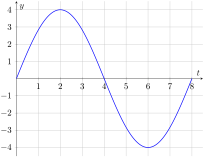
Estimate the horizontal and vertical intercepts given the graph of the function.
Solution.
The vertical intercept is at \((0,0)\text{.}\) The horizontal intercepts are at \((0,0)\text{,}\) \((4,0)\text{,}\) and \((8,0)\text{.}\)

4.

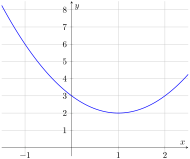
Estimate the horizontal and vertical intercepts given the graph of the function.
Solution.
The vertical intercept is at \((0,3)\text{.}\) There are no horizontal intercepts.

5.

A ball is dropped from a cliff above a lake. The ball’s height above the surface of the lake, \(h(t)\text{,}\) in feet, \(t\) seconds after the ball is dropped is given by
\begin{equation*} h(t)=300-16t^2. \end{equation*}
Find the vertical intercept of the function \(h(t)\) and the horizontal intercepts for which \(t\geq 0\text{.}\) (Round off to two decimal places.) Interpret the intercepts in practical terms.
Solution.
The vertical intercept is \(y=h(0)=300\text{.}\) This occurs when \(t=0\text{,}\) so we can say that the ball was \(300\) feet above ground when it was dropped. The horizontal intercept is when \(y=h(t)=0\text{,}\) that is when \(0=300-16t^2\text{.}\) Solving for \(t\) we get
\begin{equation*} 16t^2 = 300 \quad \implies \quad t^2 = \frac{300}{16} \quad \implies \quad t = \sqrt{300 / 16} \approx 4.33. \end{equation*}
This means that \(4.33\) seconds after the ball was dropped, it hit the ground (because the height \(h(t)\) is \(0\)).

6.

The value of a car \(V(t)\text{,}\) in dollars, \(t\) years after the car was purchased is:
\begin{equation*} V(t)=21500-1500t \end{equation*}
Find vertical and horizontal intercepts of the function \(V(t)\) and interpret them in terms of dollars and years.
Solution.
The vertical intercept is when \(t=0\text{,}\) which is \(V(0)=21500\text{.}\) This means that the car was worth \(\$21500\) at the time of purchase. The horizontal intercept is when \(V(t)=0\text{.}\) That is, \(21500-1500t=0\text{.}\) Solving this equation for \(t\) yields
\begin{equation*} 21500 = 1500t \quad \implies \quad t = \frac{21500}{1500} \approx 14.33. \end{equation*}
Therefore, \(14.33\) years after purchase the value of the car is \(\$0\text{.}\)