MTH 215 — Intro to Linear Algebra
Homework 5
Due Friday, April 24 at 11:59pm
Your work must follow the homework policies and submission guidelines in the Syllabus and on Brightspace.
- Solve the problems in this document. Your work must be handwritten (not typed).
- You need to show all your work. Correct answers without supporting work will not receive credit.
- Using techniques, theorems, definitions, etc. from material not covered in this assignment will not receive credit.
- Your work must be written on the pdf document provided. You can get another copy in class if needed.
- Submit your work as a pdf on Brightspace in the assignment titled “Homework 5-Written (pdf)”.
- Use the filename YourLastName.pdf in your submission.
- Solve the problems on the software Edfinity. Edfinity grades are computed at the semester's end.
- You do not show your work for these problems; the software only takes the final answer.
- This portion—and only this portion—is submitted entirely on Edfinity.
Both sections (in their respective formats and locations described above) are due:
Friday, April 24 at 11:59pm
Late work will not be considered!
-
Let $A = \mat{rrr} 5 & 1 & -1 \\ 1 & -3 & -2 \\ 0 & 5 & 3 \rix$.
- Compute $\Det (A)$. Is the matrix invertible or not? Why?
- Compute $\Det (A^T A)$ and $\Det (AA^T)$. Show all necessary steps.
- Suppose $B$ is an unknown $3\times 3$ matrix satisfying $\Det (2 B^T A A^T B) = 72$. What is $\Det (B)$?
-
The vectors $\vec{v}_1$ and $\vec{v}_2$ are shown on the graph below (left), and $A \vec{v}_1$ and $A \vec{v}_2$ are shown on the right, where $A$ is some $2\times 2$ matrix.
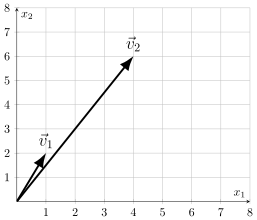
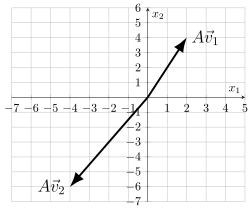
- Find the corresponding eigenvalues $\lambda_1$ and $\lambda_2$ so that $\vec{v}_1$ and $\vec{v}_2$ are eigenvectors of $A$, or argue that $\vec{v}_1, \vec{v}_2$ cannot be eigenvectors of $A$.
- If possible, find another eigenvector for $A$ parallel to $\vec{v}_2$ but not equal to $\vec{v}_2$.
- Compute $A \vec{y}$, where $\vec{y} = \mat{c} 25 \\ 36 \rix$, or state that more information is needed. Include all computations.
-
Let $A = \mat{cc} a & b \\ c & d \rix$. In this problem, assume $A$ has real eigenvalues.
- Find the characteristic polynomial of $A$. Fully expand and simplify the polynomial. Do not solve it.
- The trace of a square matrix, denoted $\Trace (A)$, is defined as the sum of the main diagonal entries. The characteristic polynomial can be rewritten in terms of $\Trace (A)$ and $\Det (A)$. Verify this, and obtain a new version of the characteristic polynomial with them.
- Using the characteristic polynomial in part (b), solve for the eigenvalues using the quadratic formula.
- Take the eigenvalues in part (c) and add them. What do you get? Show your work.
- Take the eigenvalues in part (c) and multiply them. What do you get? Show your work.
-
Let $A = \mat{ccc} a & b & c \\ d & e & f \\ g & h & i \rix$ be a $3\times 3$ matrix and let $\vec{z} = \mat{c} 1 \\ 1 \\ 1 \rix$.
- Compute $A \vec{z}$, and explain the result in a complete sentence.
- Suppose $B$ is a $3\times 3$ matrix with the property that each row sums to $0$. Show that $B$ has an eigenvalue of $0$, and find an associated eigenvector. Justify your work and thought process.
- In Homework 2, we investigated magic matrices and saw that $M = \mat{ccc} 4 & 9 & 2 \\ 3 & 5 & 7 \\ 8 & 1 & 6 \rix$ is a magic matrix. Without doing any computations, there is an obvious eigenvalue of $M$ you can find. What is it?
- The result from Question 3 Part (d) actually generalizes to $n\times n$ matrices. Using this fact, and the eigenvalue from part (c), what can be said of the other two eigenvalues of $M$? Justify your explanations. NOTE: You do NOT (and should not) have to find all eigenvalues of $M$ to answer this question!
-
URI is concerned about its internal population of squirrels. With no fences or boundaries, the population can go up (if more outside squirrels join) or down (if URI squirrels want to go explore the rest of RI). Suppose each year, $10\%$ of the URI population leaves and $1\%$ of outside squirrels find their way in. Our question is: can we reach a stable level? Will the populations of both groups stay constant over time, where the number of squirrels leaving equals the number joining?
Let $u_n$ be the population at URI in year $n$, and $r_n$ be the population in the rest of RI in year $n$. We get the following linear system: \[ \begin{aligned} 0.9 u_n + 0.01 r_n & \eq u_{n+1} \\ 0.1 u_n + 0.99 r_n & \eq r_{n+1} \end{aligned} \qquad \xrightarrow{\text{\normalsize corresponding to}} \qquad \mat{cc} 0.9 & 0.01 \\ 0.1 & 0.99 \rix \mat{c} u_n \\ r_n \rix \eq \mat{c} u_{n+1} \\ r_{n+1} \rix \] which we'll denote by $T \, \vec{p}_n = \vec{p}_{n+1} $.
- The population will be stable if $u_{n+1} = u_n$ and $r_{n+1} = r_n$. That is, if $\vec{p}_n = \vec{p}_{n+1} $. Explain why finding such a population $\vec{p}_n$ is equivalent to finding an eigenvector of $T$ associated with eigenvalue $1$.
- MATLAB Part
Using MATLAB and the
eigcommand, find the eigenvectors and eigenvalues of $T$ and write them in the space below. Then, scale the eigenvector for $\lambda =1$ so that the second component is $1$. Write this scaled version below as well. Remember to submit your .m file to Brightspace. - Assume there are $100,\!000$ squirrels in the rest of RI. Using the scaled eigenvector from part (b), what must the URI population be so that the two populations remain stable?
- MATLAB Part Let $\vec{p}_0$ denote the initial population (i.e., at time $t=0$). Let's assume in 1892, when URI was founded, there were $12$ squirrels at URI and $50,\!000$ in the rest of Rhode Island. Using the equation $T \vec{p}_n = \vec{p}_{n+1} $, find the population of the two communities 50 years later. Compute your answer in
MATLAB, and write it below.
-
Suppose $\vec{x}$ is an eigenvector of $A$ with corresponding eigenvalue $\lambda $.
- Is $\vec{x}$ an eigenvector of the matrix $5I - A$? Why or why not? If so, what is the eigenvalue? Show your steps.
- Is $\vec{x}$ an eigenvector of $5I - 3A + A^2$? Why or why not? If so, what is the eigenvalue? Show your steps.
- Conjecture what the eigenvalues of the matrix polynomial $p(A) = c_0 I + c_1 A + c_2 A^2 + \dots + c_n A^n$ are in terms of the eigenvalues of $A$.
-
- First, suppose $A$ is an arbitrary $n\times n$ matrix with eigenvector $\vec{x}$ and eigenvalue $\lambda $. Fully simplify the following expression: $\dfrac{\vec{x}^T A \vec{x}}{\vec{x}^T \vec{x}} $. Show all your work.
- Now, let $A = \mat{cc} 5 & 2 \\ 2 & 2 \rix$. Compute the eigenvalues of $A$ by hand. Show your steps (including the characteristic polynomial). Is $\vec{x} = \mat{c} 1 \\ 0 \rix$ an eigenvector?
- MATLAB Part Store $A$ (in part (b)) and
x0$= \mat{c} 1 \\ 0 \rix$, and then compute the following vectors:
Display them to the command window. Then, for each vectorx1 = A * x0,x2 = A * x1,x3 = A * x2,x4 = A * x3x1,x2,x3,x4, compute the corresponding expression in part (a) and write them in the space below (round to $6$ decimals).What do you observe? Write a sentence or two that summarizes your findings in which you explain the relevance of the vectors
x1,x2, etc. you computed along with the term in part (a).