MTH 215 — Intro to Linear Algebra
Homework 2
Due Friday, February 27 at 11:59pm
Your work must follow the homework policies and submission guidelines in the Syllabus and on Brightspace.
Written Section
- Solve the problems in this document. Your work must be handwritten (not typed).
- You need to show all your work. Correct answers without supporting work will not receive credit.
- Using techniques, theorems, definitions, etc. from material not covered in this assignment will not receive credit.
- Your work must be written on the pdf document provided. You can get another copy in class if needed.
- Submit your work as a pdf on Brightspace in the assignment titled “Homework 2-Written (pdf)”.
- Use the filename YourLastName.pdf in your submission.
Edfinity Section
- Solve the problems on the software Edfinity. Edfinity grades are computed at the semester's end.
- You do not show your work for these problems; the software only takes the final answer.
- This portion—and only this portion—is submitted entirely on Edfinity.
Both sections (in their respective formats and locations described above) are due:
Friday, February 27 at 11:59pm
Late work will not be considered!
For All Questions: If you perform row operations, you must explicitly state all operations used and show the updated matrix at each step.
-
Suppose that \[ \mat{rrrr} 1 & 2 & 1 & 2 \\ -1 & 2 & 3 & 1 \\ 2 & 3 & 1 & a \rix \mat{r} 1 \\ 2 \\ -2 \\ 3 \rix \eq \mat{c} b_1 \\ b_2 \\ b_3 \rix \] where $b_1, b_2, b_3$ are unknown.
- Compute the matrix-vector product appearing on the left-hand side.
- To determine the value of $a$, which of the $b_i$'s do we need to know?
- Suppose the $b_i$'s that we need to know are equal to $9$. What is the value of $a$?
- Define the matrix
$A = \mat{rrrr}
1 & 3 & 0 & 3 \\
-1 & -1 & -1 & 1 \\
0 & -4 & 2 & -8 \\
2 & 0 & 3 & -1
\rix$.
- Compute the reduced row echelon form (rref) of $A$. Show all row operations and display the updated matrix at each step.
- Identify which rows of $A$ have a pivot position. Is there a solution to $A \vec{x} = \vec{b}$ for all $\vec{b}$ in $\R^4$?
- Do the columns of $A$ span $\R^4$? Why or why not? Provide justification.
- If the columns of $A$ form a linearly independent set, state that and justify your answer. If they form a linearly dependent set, then find a linear dependence relationship among the columns of $A$. In either case, show all your work.
-
Let $A = \mat{rrr} -5 & 7 & 9 \\ 1 & -2 & 6 \rix$ and $\vec{b} = \mat{c} 9 \\ 15 \rix$.
- Solve $A \vec{x} = \vec{b}$ and write your solution in parametric vector form (i.e., explicitly showing any free variables). Show all row operations and intermediate steps.
- Solve $A \vec{x} = \vec{0}$. Hint: Use part (a)!
-
For each of the following (unrelated!) parts, your argument should not be a “proof by example”. You must show that for the results hold for any such vectors in $\R^n$, rather than demonstrating that it works for, e.g., two specific vectors.
- Suppose $\cbr{\vec{v}_1, \vec{v}_2}$ is a linearly independent set in $\R^n $. Verify that $\cbr{\vec{v}_1, \vec{v}_1 + \vec{v}_2}$ is also linearly independent.
- Let $T: \R^n \to \R^m $ be a linear transformation, and let $\cbr{\vec{v}_1, \vec{v}_2, \vec{v}_3}$ be a linearly dependent set in $\R^n $. Explain why the set $\cbr{T(\vec{v}_1), T(\vec{v}_2), T(\vec{v}_3)}$ in $\R^m $ is also linearly dependent.
-
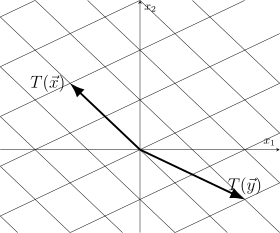
The graph of $\vec{x}, \vec{y}, \vec{w}$ in $\R^2$ are shown below on the left. On the right are $T(\vec{x})$ and $T(\vec{y})$, where $T: \R^2 \to \R^2$ is a linear transformation.
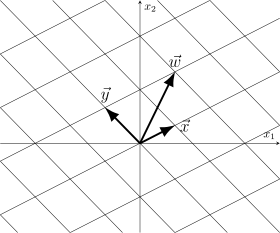
- Write $\vec{w}$ as a linear combination of $\vec{x}$ and $\vec{y}$.
- Draw $T(\vec{w})$ on the graph on the above-right.
- Are $T( \vec{u})$ and $T(\vec{v})$ linearly independent or linearly dependent? Justify your answer.
- Define the matrix
\[
A \eq
\mat{rrrrr}
8 & 11 & -6 & -7 & 13 \\
-7 & -8 & 5 & 6 & -9 \\
11 & 7 & -7 & -9 & -6 \\
-3 & 4 & 1 & 8 & 7
\rix
.\]
- (MATLAB Part) Find the reduced row echelon form (RREF) of this matrix using MATLAB. To do so, store the matrix $A$ as the variable $A$ in your code, and then enter
rref(A). Do not use a semicolon at the end of the line so that the output is displayed to the command window. On Brightspace, submit the .m file that shows your work for this part. Write the RREF of $A$ in the space below. - Do the columns of $A$ span $\R^4$? Why or why not? Provide justification.
- If you said “yes” to part (b)—can you remove some columns of $A$ such that the remaining columns still span $\R^4$? Why or why not? If so, indicate clearly which column(s) can be removed. If you said “no” to part (b)—list vector(s) that must be added to the matrix $A$ such that its columns span $\R^4$.
- (MATLAB Part) Find the reduced row echelon form (RREF) of this matrix using MATLAB. To do so, store the matrix $A$ as the variable $A$ in your code, and then enter
-
A square $n\times n$ matrix, consisting of integers, is called magic if each row, column, and both diagonals add to the same number. For example,
$\mat{ccc}
4 & 9 & 2 \\
3 & 5 & 7 \\
8 & 1 & 6
\rix$ is a $3\times 3$ magic matrix because each row, column, and diagonal sum to $15$, which we say is the magic sum of this matrix. In fact, this matrix uses all numbers $\cbr{1, 2, \dots , 3^2}$ only once, so we call this matrix super magic. Why super? Because you could generate magic matrices by only using one number (boring!), so there is something special about this matrix.
- Let $A = \mat{cc} a & b \\ c & d \rix$ where the entries are unknown. Suppose $A$ has magic sum $s$ which we assume to be known. This yields a system of equations in the variables $a, b, c, d$, shown below, along with the corresponding augmented matrix in row echelon form: \[ \begin{array}{ccccccccc} a &+& b & & & & &=& s \\ & & & & c &+& d &=& s \\ a &+& & & c & & &=& s \\ & & b & & &+& d &=& s \\ a &+& & & &+& d &=& s \\ & & b &+& c & & &=& s \end{array} \qquad \xrightarrow{\text{\normalsize Row Ops.}} \qquad \mat{cccc|c} 1 & 1 & 0 & 0 & s \\ 0 & 1 & 0 & 1 & s \\ 0 & 0 & 1 & 1 & s \\ 0 & 0 & 0 & 2 & s \\ 0 & 0 & 0 & 0 & 0 \\ 0 & 0 & 0 & 0 & 0 \\ \rix .\] Using this row echelon form, solve the system for the variables $a,b,c,d$.
- If possible, find one $2\times 2$ super magic matrix. Or, state that it is impossible. Justify your answers.
- What about $3\times 3$ magic matrices? Let $A = \mat{ccc} a & b & c \\ d & e & f \\ g & h & i \rix $. Suppose the magic sum is $s = 3$. A linear system in the variables $(a, b, c, d, e, f, g, h ,i)$ with an $8\times 9$ coefficient matrix can be obtained similarly to the $2\times 2$ case. Here, the right-hand side vector is an $8\times 1$ vector of $3$'s (since $s=3$). The corresponding augmented matrix has a rref of the following: \[ \mat{rrrrrrrrr|r} 1 & 0 & 0 & 0 & 0 & 0 & 0 & 0 & 1 & 2 \\ 0 & 1 & 0 & 0 & 0 & 0 & 0 & 1 & 0 & 2 \\ 0 & 0 & 1 & 0 & 0 & 0 & 0 & -1 & -1 & -1 \\ 0 & 0 & 0 & 1 & 0 & 0 & 0 & -1 & -2 & -2 \\ 0 & 0 & 0 & 0 & 1 & 0 & 0 & 0 & 0 & 1 \\ 0 & 0 & 0 & 0 & 0 & 1 & 0 & 1 & 2 & 4 \\ 0 & 0 & 0 & 0 & 0 & 0 & 1 & 1 & 1 & 3 \\ 0 & 0 & 0 & 0 & 0 & 0 & 0 & 0 & 0 & 0 \rix .\] Describe the solution set $(a, b, c, d, e, f, g, h ,i)$ in parametric vector form. Explicitly state any free variables of the system.
- Generate two unique $3\times 3$ magic matrices. They do not have to be super magic! Utilize your answer from part (c), and state the values of any free variable(s) you used.
- Optional Bonus -- MATLAB Part This part is entirely optional! Substantial progress may award a bonus 5 points on this assignment (not to exceed 100\%). MATLAB code must be submitted. Attempt to find a $3\times 3$ super magic matrix. To get you started, the coefficient matrix that was used for part (c) is included in the template MATLAB file on Brightspace. This can be done using an exhaustive search (hence why this is a coding question) or by clever calculations and logical reasoning. I will say that there are no super magic $3\times 3$ matrices with a sum of $s=3$. Therefore, you need to use a different sum.
-
Consider the linear system
\[
\begin{array}{ccccc}
x &+& 3y &=& k \\
4x &+& hy &=& 8
\end{array}
.\]
- Determine values of $h$ and $k$ for which the system is inconsistent. Justify your answer.
- Determine values of $h$ and $k$ for which the system has a unique solution. Justify your answer.
- Determine values of $h$ and $k$ for which the system has infinitely many solutions. Justify your answer.
- Determine values of $h$ and $k$ for which $x=5, y=6$ is a solution. Justify your answer.