MTH 215 — Intro to Linear Algebra
Homework 1
Due Friday, February 6 at 11:59pm
Your work must follow the homework policies and submission guidelines in the Syllabus and on Brightspace.
- Solve the problems in this document. Your work must be handwritten (not typed).
- You need to show all your work. Correct answers without supporting work will not receive credit.
- Using techniques, theorems, definitions, etc. from material not covered in this assignment will not receive credit.
- Your work must be written on the pdf document provided. You can get another copy in class if needed.
- Submit your work as a pdf on Brightspace in the assignment titled “Homework 1-Written (pdf)”.
- Use the filename YourLastName.pdf in your submission.
- Solve the problems on the software Edfinity. Edfinity grades are computed at the semester's end.
- You do not show your work for these problems; the software only takes the final answer.
- This portion—and only this portion—is submitted entirely on Edfinity.
Both sections (in their respective formats and locations described above) are due:
Friday, February 6 at 11:59pm
Late work will not be considered!
-
Write the augmented matrix for the following linear system: \[ \begin{array}{rcrcrcrcr} x_1 && && &-&2x_4 &=& -3 \\ && 2x_2 &+& 2x_3 && &=& 0 \\ && && x_3 &+& 3x_4 &=& 1 \\ -2x_1 &+& 3x_2 &+& 2x_3 &+& x_4 &=& 5 \end{array} .\] Then, row reduce the augmented matrix to its reduced row-echelon form (RREF) and solve the linear system.
-
Find the solution to the linear system whose augmented matrix is \[ \mat{rrr|r} 1 & -2 & -1 & 3 \\ 3 & -6 & -2 & 2 \rix .\] You must explicitly state all row operations used and show the updated matrix at each step.
-
Each augmented matrix below is in row echelon form. The entries denoted with a $\blacksquare$ represent nonzero values, and the $\ast $ entries could be zero or nonzero.
Determine if the corresponding linear system is consistent, not consistent, or if there is not enough information.
If the system is consistent, is the solution unique? Are there free variables?
Your answers must be justified with appropriate results, statements, or work.- $\mat{cc|c} \blacksquare & \ast & \ast \\ 0 &\blacksquare & \ast \\ 0 & 0 & 0 \rix$
- $\mat{cccc|c} \blacksquare & \ast & \ast & \ast & \ast \\ 0 & 0 & \blacksquare & \ast & \ast \\ 0 & 0 & 0 & \blacksquare & \ast \rix$
- $\mat{cc|c} \blacksquare & \ast & 0 \\ 0 & \blacksquare & 0 \\ \rix$
- $\mat{cccc|c} 0 & \blacksquare & \ast & \ast & 0 \\ 0 & 0 & \blacksquare & \ast & 0 \\ 0 & 0 & 0 & 0 & \blacksquare \rix$
- $\mat{cccc|c} \blacksquare & \ast & \ast & \ast & 0 \\ 0 & 0 & \blacksquare & \ast & 0\\ 0 & 0 & 0 & 0 & 0 \rix$
-
Define the vectors \[ \vec{a}_1 = \mat{c} 1 \\ 0 \\ 1 \rix, \qquad \vec{a}_2 = \mat{r} -2 \\ 3 \\ -2 \rix, \qquad \vec{a}_3 = \mat{r} -6 \\ 7 \\ 5 \rix, \qquad \vec{b} = \mat{r} 14 \\ -14 \\ -8 \rix .\]
- Is $\vec{b}$ a linear combination of $\vec{a}_1, \vec{a}_2, \vec{a}_3$? If so, determine the weights. Show all your work.
- Is $\vec{b}$ in $\Span \cbr{\vec{a}_1, \vec{a}_3}$? Justify your answer. Hint: Use part (a).
-
A chess board is an $8 \times 8$ grid. To refer to individual positions on the board, we place the board so that its lower left corner is at the origin, make each square in the grid have side length $1$, and label each square with the point.
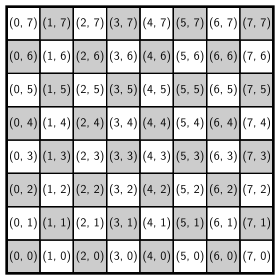
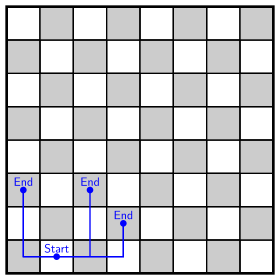
Suppose a knight starts at $(1,0)$, as shown above. This knight has only three allowable moves from its starting point.
Our Question: Given any position on the board, can the knight move from its start position to that position using only knight moves and, what sequence of moves will make that happen?
Each knight move can be described by a vector: \[ \vec{n}_1 = \mat{c} 1 \\ 2 \rix, \quad \vec{n}_2 = \mat{r} -1 \\ 2 \rix, \quad \vec{n}_3 = \mat{c} 2 \\ 1 \rix,\quad \vec{n}_4 = \mat{r} -2 \\ 1 \rix .\] For example, a move one position right and two up is given by $\vec{n}_1$. The other four knight moves are the negatives of these four. Therefore, any sequence of moves by the knight is given by the linear combination \[ x_1 \vec{n}_1 + x_2 \vec{n}_2 + x_3 \vec{n}_3 + x_4 \vec{n}_4. \] A word of caution: the knight can only make complete moves, so we are restricted to integer (either positive or negative) values for $x_1$, $x_2$, $x_3$, and $x_4$. Since addition of vectors is commutative, the order in which we apply our moves does not matter. However, we may need to be careful with the order so that our knight does not leave the chess board.
-
Explain why the vector equation \[ \mat{c} 1 \\ 0 \rix + x_1 \vec{n}_1 + x_2 \vec{n}_2 + x_3 \vec{n}_3 + x_4 \vec{n}_4 = \mat{c} 5 \\ 2 \rix \] will tell us if it is possible for the knight to move from its initial position at $(1,0)$ to the position $(5,2)$.
-
Provide two distinct solutions to the vector equation in part (a). (Be careful—we must have solutions in which $x_1$, $x_2$, $x_3$, and $x_4$ are integers.) You can check your solution with the GeoGebra app at https://www.geogebra.org/m/dfwtskrj.
-
-
A company has two mines, $M_1$ and $M_2$. During each day of operation, $M_1$ produces ore that contains $20$ metric tons of copper and $550$ kilograms of silver, meanwhile $M_2$ produces ore that contains $30$ metric tons of copper and $500$ kilograms of silver.
Let $\vec{v}_1 = \mat{c} 20 \\ 550 \rix$ and $\vec{v}_2 = \mat{c} 30 \\ 500 \rix$, which represent the daily output of mine $M_1$ and $M_2$, respectively.
- Compute $5 \vec{v}_1$. Then, in words, describe what $5 \vec{v}_1$ represents in the context of this problem.
- The company operates $M_1$ for $x_1$ days and $M_2$ for $x_2$ days. Write a vector equation which gives the number of days each mine should operate in order to produce $150$ tons of copper and $2825$ kilograms of silver. Do not solve the equation.
- (MATLAB part) Write your vector equation from part (b) as a linear system $A \vec{x} = \vec{b}$ and store the matrix $A$ and vector $\vec{b}$ as variables $A$ and $b$ in MATLAB. Then, using the “back-slash” command, solve the system. Print your solution vector $\vec{x}$ to the command window by typing x on a line by itself with no semicolon at the end.
Below, write your solution $x_1$ and $x_2$ generated from your code. Interpret your result in the context of the problem.
-
Given three distinct points $(x_1, y_1), \, (x_2, y_2), \, (x_3, y_3)$ in the plane, there is only one quadratic polynomial $p(x)$ which goes through these points. This is an example of polynomial curve fitting.
We seek a polynomial of the form
\[
p(x) \eq a_2x^2 + a_1x+a_0
\] where the $a_2, a_1, a_0$ coefficients are unknown at this time.
- Suppose the points are $(-1,2)$, $(1,6)$, and $(2,5)$. Substitute them into the polynomial. In the space below, write the resulting linear system in the unknowns $a_2$, $a_1$, $a_0$.
- Write the augmented matrix corresponding to the linear system in part (a).
- (MATLAB part) In MATLAB, enter the coefficient matrix and right-hand side vector with variables $A$ and $b$, respectively. Then, using the backslash command, solve the system. Your code should display the solution vector $\vec{x}$ to the command window.
In the space below, write the formula for the polynomial $p(x)$ you get. - Now, suppose you are given $f(x) = \sin (x)$ that we want to interpolate at $x_0 = -\frac{\pi}{2}, x_1 = -\frac{\pi}{4}, x_2 = 0$. That is, we want the polynomial $p(x)$ such that $p(x_0) = f(x_0)$, $p(x_1) = f(x_1)$, and $p(x_2) = f(x_2)$.
First, compute the corresponding $y_0, y_1, y_2$ values (i.e., evaluate $f$ at these $x$ values). Then, construct the linear system similar to how you did in part (a). Write this answer below. - (MATLAB part) In the same MATLAB file used for part (c), enter the new coefficient matrix and right-hand side vector for your new system in part (d). Then, solve the system using the backslash command.
Below, write the formula for the polynomial $p(x)$. (Round decimals to four places.)