MTH 215 — Intro to Linear Algebra
Section 1.1: Systems of Linear Equations
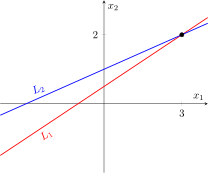
Our goal: Solve a collection of equations, such as:
|
\begin{align*} x_1 - 2x_2 & \eq -1 & (L_1) & \\ -x_1 + 3x_2 & \eq 3 & (L_2) & \end{align*} |
|
\[ \begin{array}{crcc} & x_1 - 2x_2 & = & -1 \\ + & \\ & -x_1 + 3x_2 & = & 3 \\[1em]\hline & \\ \end{array} \] |
The solution is a pair of numbers $(x_1,x_2)$ satisfying both equations.
Nonlinear equations like $4x_1-6x_2=x_1x_2$ or $x_2 = 2 \sqrt{x_1} + 5$ are not our interest!
For example -- the above solution set is only $x_1=3, x_2 = 2$. Can solution sets be larger? Can no solutions exist? Infinitely many?
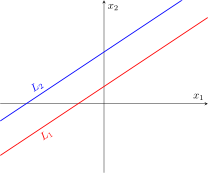
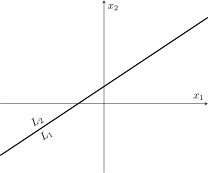
From our knowledge of linear equations, what are other possibilities for the solution set?
Consider slight variations of the linear system above:
|
\begin{align*} x_1 - 2x_2 & = -1 && (L_1) \\ -x_1+2x_2 & = 3 && (L_2) \end{align*} |
\begin{align*} x_1 - 2x_2 & = -1 && (L_1) \\ -x_1+2x_2 & = 1 && (L_2) \end{align*} |
|
|
- One solution.
- Infinitely many solutions.
- No solutions.
A major goal of this class is to classify a linear system as consistent or inconsistent. And, to say how many solutions there are (if any).
The two-variable systems above are easy—what about more variables?
\[ \begin{array}{rcrcrcr} x_1 &-& 2x_2 &+& x_3 &=& 0 \\ && x_2 &-& 4x_3 &=& 4 \\ && && x_3 &=& -1 \end{array} \] Working from the bottom upwards: \[ \begin{array}{ccclcl} x_3 &= -1 & \qquad\qquad\qquad x_2 & = & \qquad\qquad\qquad\qquad\qquad x_1 & = \\[1em] & & &= \quad & & = \\[1em] & & &= \quad & & = \end{array} \]
Therefore, we'll convert “hard to solve” systems into equivalent but “easy to solve” systems.
To do so, it's helpful to store only the essential information of a system. The coefficients of the variables are stored in a coefficient matrix, and the known values (often appearing on the right-hand side) form the last column in the augmented matrix.
For example, in this linear system, we have the following matrices: \[ \begin{array}{rcrcrcr} x_1 &-& 2x_2 &+& x_3 &=& 0 \\ && 2x_2 &-& 8x_3 &=& 8 \\ 5x_1 && &-& 5x_3 &=& 10 \end{array} \]
The size of a matrix is: (number of rows) $\times $ (number of columns). For example:
| $\mat{crr} 1 & -2 & 1 \\ 0 & 2 & -8 \\ 5 & 0 & -5 \rix$ | $ \mat{crr|c} 1 & -2 & 1 & 0 \\ 0 & 2 & -8 & 8 \\ 5 & 0 & -5 & 10 \rix$ | $\mat{rr} 1 & 0 \\ -5 & 8 \rix$ | $\mat{rrr|r} 1 & 2 & 3 & 4 \\ 5 & 6 & 7 & 8 \rix$ |
Therefore, a system of $m$ equations with $n$ unknowns is associated to:
- a coefficient matrix of size:
- an augmented matrix of size:
For example, this coefficient matrix is $3\times 3$, the augmented matrix is $3\times 4$. In general, an $m \times n$ matrix has $m$ rows and $n$ columns. Order matters!
Solving a linear system: To solve a linear system, create the augmented matrix. Our goal is to convert this matrix to an equivalent system (so, not changing the solution set) which is easier to solve.
- (Replacement) Replace one row by the sum of that row and a multiple of another.That is, add to one row a multiple of another row.
- (Interchange) Interchange two rows.
- (Scaling) Multiply a row by a nonzero constant.
Section 1.2: Row Reduction and Echelon Forms
In past examples, we performed row operations and obtained “special” matrices \[ \mat{rrrr} 2 & -3 & 2 & 1 \\ 0 & 1 & -4 & 8 \\ 0 & 0 & 0 & 15 \rix \quad \text{and} \quad \mat{crr} 1 & 0 & 0 \\ 0 & 1 & 0 \\ 0 & 0 & 1 \rix .\] (They were augmented matrices, but the following applies to any matrix.) In this section, we describe a procedure for “reducing” matrices to this desired form.
- All nonzero rows are above any rows of all zeros.
- Each leading entry of a row (the leftmost nonzero entry) is in a column to the right of the leading entry of the row above it.
- All entries in a column below a leading entry are zero.
For example: these are in $\REF$. Leading entries are the $\blacksquare$, and $\ast$ denotes anything. \[ \mat{cccc} \blacksquare & \ast & \ast & \ast \\ 0 & \blacksquare & \ast & \ast \\ 0 & 0 & 0 & 0 \\ 0 & 0 & 0 & 0 \rix \qquad \mat{ccc} \blacksquare & \ast & \ast \\ 0 & \blacksquare & \ast \\ 0 & 0 & \blacksquare \\ 0 & 0 & 0 \rix \qquad \mat{ccccccccccc} 0 & \blacksquare & \ast & \ast & \ast & \ast & \ast & \ast & \ast & \ast & \ast \\ 0 & 0 & 0 & \blacksquare & \ast & \ast & \ast & \ast & \ast & \ast & \ast \\ 0 & 0 & 0 & 0 & \blacksquare & \ast & \ast & \ast & \ast & \ast & \ast \\ 0 & 0 & 0 & 0 & 0 & 0 & \blacksquare & \ast & \ast & \ast & \ast \\ 0 & 0 & 0 & 0 & 0 & 0 & 0 & \blacksquare & \ast & \ast & \ast \rix .\]
- It is in $\REF$.
- The leading entry in each nonzero row is $1$.
- Each leading $1$ is the only nonzero entry in its column.
For example: the above matrices in $\RREF$ are:
| $\mat{cccc} \blacksquare & \ast & \ast & \ast \\ 0 & \blacksquare & \ast & \ast \\ 0 & 0 & 0 & 0 \\ 0 & 0 & 0 & 0 \rix$ | $\mat{ccc} \blacksquare & \ast & \ast \\ 0 & \blacksquare & \ast \\ 0 & 0 & \blacksquare \\ 0 & 0 & 0 \rix$ | $\mat{ccccccccccc} 0 & \blacksquare & \ast & \ast & \ast & \ast & \ast & \ast & \ast & \ast & \ast \\ 0 & 0 & 0 & \blacksquare & \ast & \ast & \ast & \ast & \ast & \ast & \ast \\ 0 & 0 & 0 & 0 & \blacksquare & \ast & \ast & \ast & \ast & \ast & \ast \\ 0 & 0 & 0 & 0 & 0 & 0 & \blacksquare & \ast & \ast & \ast & \ast \\ 0 & 0 & 0 & 0 & 0 & 0 & 0 & \blacksquare & \ast & \ast & \ast \rix$ | $\mat{cccc} 1 & 0 & \ast & \ast \\ 0 & 1 & \ast & \ast \\ 0 & 0 & 0 & 0 \\ 0 & 0 & 0 & 0 \rix$ | $\mat{ccc} 1 & 0 & 0 \\ 0 & 1 & 0 \\ 0 & 0 & 1 \\ 0 & 0 & 0 \rix$ | $\mat{ccccccccccc} 0 & 1 & \ast & 0 & 0 & \ast & 0 & 0 & \ast & \ast & \ast \\ 0 & 0 & 0 & 1 & 0 & \ast & 0 & 0 & \ast & \ast & \ast \\ 0 & 0 & 0 & 0 & 1 & \ast & 0 & 0 & \ast & \ast & \ast \\ 0 & 0 & 0 & 0 & 0 & 0 & 1 & 0 & \ast & \ast & \ast \\ 0 & 0 & 0 & 0 & 0 & 0 & 0 & 1 & \ast & \ast & \ast \rix$ |
- A pivot position is a location of a leading entry in a $\REF$ of a matrix.
- A pivot is nonzero number in a pivot position used to create zeros via row operations.
- A pivot column is a column that contains a pivot position.
- Start with leftmost nonzero column. The pivot position is the top.
- If needed, do a row swap to put a (nonzero) pivot in the pivot position.
- Do row operations to zero out all positions below the pivot.
- Ignore this row (and everything above). Apply steps 1--3 to the submatrix that remains. Repeat until there are no more rows to modify.
- Start with rightmost pivot. Work upward and to the left to create zeros above each pivot. Make each pivot $1$ by scaling.
Applying these row reduction steps to the augmented matrix of a linear system allows us to explicitly describe the solution set.
- Variables that correspond to pivot columns are called basic variables.
- Variables that correspond to columns without a pivot are called free variables or nonbasic variables.
Even though the $\REF$ is insufficient to solve a linear system, it does answer if the system is consistent or not (and, how many solutions there are, if any).
- a unique solution, if there are no free variables;
- infinitely many solutions, if there is at least one free variable.
Suppose a linear system is consistent. To determine if there is a unique solution, what must be true about the pivot locations? Does every row need a pivot? Does every column need a pivot? Think about it!
In summary: To solve a linear system, use the following procedure.
- Write the augmented matrix of the system.
- Obtain the $\REF$ of the augmented matrix.
- If a row of $\mat{ccc|c} 0 & \dots & 0 & c \rix$ where $c\neq 0$ is encountered, stop. There are no solutions.
- Otherwise, continue.
- Continuing row reducing to obtain the $\RREF$.
- Write the system of equations obtained from the $\RREF$.
- Rewrite each equation so that its basic variable is in terms of any free variables.
- What is the largest possible number of pivots a $4\times 6$ matrix can have?
- What is the largest possible number of pivots a $6\times 4$ matrix can have?
- A consistent linear system has $3$ equations and $4$ unknowns. How many solutions does it have?
- Suppose the coefficient matrix corresponding to a linear system is $4\times 6$ with $3$ pivot columns. How many pivot columns does the augmented matrix have, if the linear system is inconsistent?
Section 1.3: Vector Equations
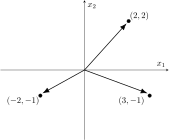
Vectors are just an ordered list of numbers. Their relevance to linear systems is immediate.For example, the following are two-dimensional vectors: \[ \vec{u} = \mat{r} 3 \\ -1 \rix, \qquad \vec{v} = \mat{c} \pi \\ 0.1 \rix, \qquad \vec{w} = \mat{r} -0.5 \\ 45 \rix , \qquad \vec{x} = \mat{r} 2 \\ 2 \rix \]
|
Each point $(x_1,x_2)$ in the plane corresponds to a vector $\mat{c} x_1 \\ x_2 \rix$ in $\R^2$: |
|
\[ \R^2 \eq \Bigg\{ \hspace{12em} \Bigg\} .\]
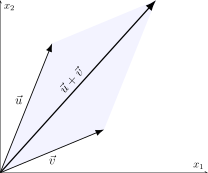
Vector Addition: We can add two vectors by adding corresponding components: \[ \vec{u} = \mat{c} 1 \\ 3 \rix \qquad \vec{v} = \mat{c} 2 \\ 1 \rix \qquad \text{yields} \qquad \vec{u} + \vec{v} = \hspace{5em} \] Geometrically, this is the so-called parallelogram rule.
|
If $\vec{u}$ and $\vec{v}$ are vectors in $\R^2$, then $\vec{u} + \vec{v}$ is the fourth vertex of a parallelogram with vertices $\vec{u}, \vec{v}, \vec{0}$.
|
|
Note that $\vec{0} = \mat{c} 0 \\ 0 \rix$ in $\R^2$.
Vector Scaling: We can multiply a vector $\vec{x}$ by a scalar $c \in \R $. \[ \vec{x} = \mat{r} 1 \\ -2 \rix \qquad 3 \vec{x} = \mat{c} 3\cdot 1 \\ 3\cdot -2 \rix = \mat{r} 3 \\ -6 \rix, \qquad -2 \vec{x} = \mat{r} -2 \\ 4 \rix, \qquad \frac{1}{2}\vec{x} = \mat{c} 1 /2 \\ -1 \rix .\]
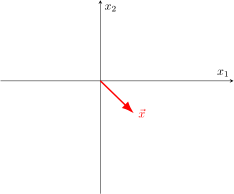
Vectors in $\R^n $: Everything we have done above extends naturally to higher dimensional spaces. Namely, for an arbitrary integer $n$.
- $\vec{u} + \vec{v} = \vec{v} + \vec{u}$
- $(\vec{u} + \vec{v}) + \vec{w} = \vec{u} + (\vec{v} + \vec{w})$
- $\vec{u} + \vec{0} = \vec{u}$
- $\vec{u} + (-1)\vec{u} = \vec{u} - \vec{u} = \vec{0}$
- $c (\vec{u} + \vec{v}) = c \vec{u} + c \vec{v}$
- $(c+d) \vec{u} = c \vec{u} + d \vec{u}$
- $c (d \vec{u}) = (cd) \vec{u}$
- $1 \vec{u} = \vec{u}$
Adding and scaling vectors gives another vector (still in $\R^n $, say) which we call a linear combination.
- $2 \vec{v}_1 + \frac{1}{2} \vec{v}_2$
- $-\vec{v}_1 + \sqrt{2} \, \vec{v}_2$
- $4 \vec{v}_2$
- $\vec{0}$
- $\vec{v}_1 - \vec{v}_2$
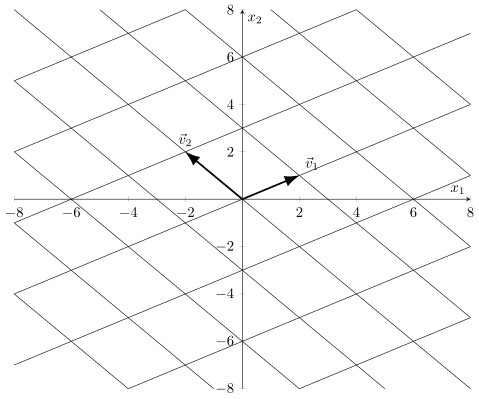
In general, the last example is hard! to solve. Actually, it's one of the major goals of linear algebra!
For example, take the vectors \[ \vec{a}_1 = \mat{c} 1 \\ 0 \\ 3 \rix \quad \vec{a}_2 = \mat{c} 4 \\ 2 \\ 14 \rix \quad \vec{a}_3 = \mat{c} 3 \\ 6 \\ 10 \rix \quad \vec{b} = \mat{r} -1 \\ 8 \\ -5 \rix .\] Is $\vec{b}$ a linear combination of $\vec{a}_1, \vec{a}_2, \vec{a}_3$? That is, do there exist weights $c_1, c_2, c_3 \in \R $ such that
This vector equation can be written as
which can, in turn, be written as the following augmented matrix and then row reduced: \[ \hspace{10em} \quad \xrightarrow{\text{\normalsize Row Ops.}} \quad \]
Therefore, the weights in the linear combination are found to be \[ c_1 = \qquad\quad c_2 = \qquad \quad c_3 = \]
- Describe $\Span \cbr{\vec{u}}$.
- Describe $\Span \cbr{\vec{u}, \vec{v}}$ when $\vec{u}$ is not a scalar multiple of $\vec{v}$.
- Describe $\Span \cbr{\vec{u}, \vec{v}}$ when $\vec{u}$ is a scalar multiple of $\vec{v}$.
- When is $\vec{0}$ in $\Span \cbr{\vec{u}}$? In $\Span \cbr{\vec{v}}$? In $\Span \cbr{\vec{u}, \vec{v}}$?
Section 1.4: The Matrix Equation Ax=b
In this section we define multiplication of a matrix by a vector.Note: This requires that \[ \text{Number of columns of } A \eq \text{Number of entries in } \vec{x} .\]
Now, we have three equivalent ways to view a linear system:
- As a system of linear equations: \[ \begin{array}{rcrcrcr} 1\cdot x_1 &+& 4\cdot x_2 &+& 3\cdot x_3 &=& -1 \\ 0\cdot x_1 &+& 2\cdot x_2 &+& 6\cdot x_3 &=& 8 \\ 3\cdot x_1 &+& 14\cdot x_2 &+& 10\cdot x_3 &=& -5 \end{array} .\]
- As a vector equation: \[ x_1 \mat{c} 1 \\ 0 \\ 3 \rix + x_2 \mat{c} 4 \\ 2 \\ 14 \rix + x_3 \mat{c} 3 \\ 6 \\ 10 \rix \eq \mat{r} -1 \\ 8 \\ -5 \rix .\]
- As a matrix equation: \[ \mat{ccc} 1 & 4 & 3 \\ 0 & 2 & 6 \\ 3 & 14 & 10 \rix \mat{c} x_1 \\ x_2 \\ x_3 \rix \eq \mat{r} -1 \\ 8 \\ -5 \rix .\]
Then:
- The matrix equation $A \vec{x}=\vec{b}$;
- The vector equation $x_1 \vec{a}_1 + \dots + x_n \vec{a}_n = \vec{b}$;
- The augmented matrix $\mat{ccc|c} \vec{a}_1 & \dots & \vec{a}_n & \vec{b} \rix$
Furthermore, by it follows that:
In Section 1.3, we asked if a given vector $\vec{b}$ was in $\Span \cbr{\vec{a}_1, \dots , \vec{a}_n}$. By , the answer can be determined by asking if $A \vec{x} = \vec{b}$ has a solution (i.e., is consistent).
Now—is any vector $\vec{b}$ in $\Span \cbr{\vec{a}_1, \dots , \vec{a}_n}$? That is, does the linear system $A \vec{x} = \vec{b}$ have a solution for all $\vec{b}$?
In the last example, do the columns of $A$ span $\R ^3$?
The next theorem is critically important!
- The equation $A \vec{x} = \vec{b}$ has a solution for every $\vec{b} \in \R^m $.
- Every $\vec{b} \in \R^m $ is a linear combination of the columns of $A$.
- The columns of $A$ span $\R^m $.
- $A$ has a pivot position in every row.
On the other hand, suppose (1) is true. We will assume (4) is false, and then obtain a contradiction. In any row echelon form $\mat{c|c} U & \vec{d} \rix$ of $\mat{c|c} A & \vec{b} \rix$, then the last row of $U$ consists of zeros because we assumed that (4) is false and hence $A$ does not have a pivot in (at least) one row. Suppose we chose $\vec{b}$ so that the last entry of $\vec{d}$ is nonzero. This contradicts that $A \vec{x} = \vec{b}$ is consistent since the last row of $\mat{c|c} U & \vec{d} \rix$ is of the form $\mat{ccc|c} 0 & \dots & 0 & d \rix$ where $d\neq 0$. Therefore, if (1) is true then (4) must be true.
There is another way to compute $A \vec{x}$, other than strict use of the definition (as a linear combination of the columns of $A$).
The idea is to notice that each entry in $A \vec{x}$ is a sum of products (actually, a “dot product”) from the corresponding row of $A$ with the vector $\vec{x}$. For example, the first entry is computed as \[ \mat{ccc} 2 & 3 & 4 \\ \\ \\ \rix \mat{c} x_1 \\ x_2 \\ x_3 \rix \eq \] \[ \mat{ccc} \\ -1 & 5 & -3 \\ \\ \rix \mat{c} x_1 \\ x_2 \\ x_3 \rix \eq \] \[ \mat{ccc} \\ \\ 6 & -2 & 8 \rix \mat{c} x_1 \\ x_2 \\ x_3 \rix \eq \] All together, the product is \[ A \vec{x} \eq \]
Section 1.5: Solution Sets of Linear Systems
Here, we look into homogeneous systems of linear equations—where the right-hand side is $\vec{0}$.
The equation $A \vec{x} = \vec{0}$ ALWAYS has a solution. Namely, $\vec{x} = \vec{0}$. We call this the trivial solution.
The question is: are there nontrivial solutions? That is, a vector $\vec{x}$ such that $A \vec{x} = \vec{0}$ but $\vec{x} \neq \vec{0}$?
Quick Aside—Notice how this question would never apply to, for example, the real numbers. If $a$ and $x$ are real numbers, then $ax=0$ means either $a=0$ or $x=0$. For matrix-vector products, one can (often!) have $A \vec{x} = \vec{0}$ without $A$ or $\vec{x}$ being entirely zero.
Recall the Existence and Uniqueness Theorem () from Section 1.2—a linear system is consistent if and only if a row of the following form is never encountered while doing row operations: \[ \mat{ccc|c} 0 & \dots & 0 & c \rix, \qquad c\neq 0 .\] A homogeneous system will always have zeros in the last column of the augmented matrix: \[ \mat{c|c} A & \vec{0} \rix .\] So it is impossible for a zero row with nonzero right-hand side to appear. Not only does this confirm that homogeneous systems are always consistent, but also tells us the following.
The augmented matrix is \[ \hspace{10em} \quad \xrightarrow{\text{\normalsize Row Ops.}} \quad \hspace{10em} \quad \xrightarrow{\text{\normalsize Row Ops.}} \quad \]
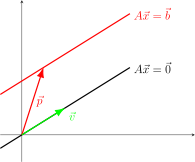
\[ \vec{x} \eq \mat{c} x_1 \\ x_2 \\ x_3 \rix \eq \] In these examples, the solutions $\vec{x}$ are in parametric vector form.This result means that the solution set of $A \vec{x} = \vec{b}$ is obtained from translating the solution set of $A \vec{x} = \vec{0}$ by any solution of $A \vec{x} = \vec{b}$.
Section 1.7: Linear Independence
A homogeneous system like \[ \mat{rrr} 1 & 2 & -3 \\ 3 & 5 & 9 \\ 5 & 9 & 3 \rix \mat{c} x_1 \\ x_2 \\ x_3 \rix \eq \mat{c} 0 \\ 0 \\ 0 \rix \] can be viewed as a vector equation \[ x_1 \mat{c} 1 \\ 3 \\ 5 \rix + x_2 \mat{c} 2 \\ 5 \\ 9 \rix + x_3 \mat{r} -3 \\ 9 \\ 3 \rix \eq \mat{c} 0 \\ 0 \\ 0 \rix .\] Are there nontrivial solutions? Or, is $\vec{0}$ the only solution?
Row reduce the augmented matrix: \[ \mat{rrr|r} 1 & 2 & -3 &0 \\ 3 & 5 & 9 & 0 \\ 5 & 9 & 3 & 0 \rix \qquad\quad \begin{aligned} R_2 &\leftarrow R_2 - 3 R_1 \\[0.5em] R_3 & \leftarrow R_3 -5 R_1 \\[0.5em] R_3 & \leftarrow R_3 - R_2 \\[0.5em] R_1 & \leftarrow R_1 + 2 R_2 \end{aligned} \qquad\quad \hspace{15em} \] This yields the solution set: \[ \mat{c} x_1 \\ x_2 \\ x_3 \rix \eq \hspace{5em} \eq \hspace{5em} \]
This result is very helpful in determining any linear dependencies in the columns of $A$ when given the $\RREF$.
From , $c_1 \vec{v}_1 + c_2 \vec{v}_2 + \dots + c_p \vec{v}_p =\vec{0}$ has the same solution set as the homogeneous equation \[ \mat{cccc|c} \vec{v}_1 & \vec{v_2} & \dots & \vec{v}_p & \vec{0} \rix \] which has a nontrivial solution if and only if there is at least one free variable.
Observe that \[ A \quad \xrightarrow{\text{\normalsize Row Ops.}} \quad \mat{rrrrr} 1 & 0 & 0 & -4 & 1 \\ 0 & 1 & 0 & 2 & 0 \\ 0 & 0 & 1 & 3 & -1 \rix .\]
(A Set of One Vector) Consider $\cbr{\vec{v}_1}$. Is the set linearly independent?
(A Set with Two Vectors) Consider $\cbr{\vec{v}_1, \vec{v}_2}$. Is the set linearly independent?
For sake of argument, suppose $\vec{v}_1\neq \vec{0} \neq \vec{v}_2$. We determine if there are nontrivial solutions to
\[
c_1 \vec{v}_1 + c_2 \vec{v}_2 \eq \vec{0}
.\] If $c_1\neq 0$, then $\vec{v}_1 = -\dfrac{c_2}{c_1} \, \vec{v}_2$.
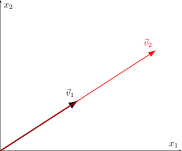
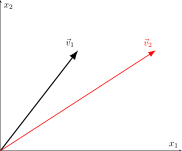
Therefore, a set of two vectors is linearly independent if and only if the vectors are not scalar multiples of each other.
Geometrically, two vectors are linearly independent if and only if they do not lie on the same line through the origin.
|
|
Generalizing further, $\cbr{\vec{u}, \vec{v}, \vec{w}}$ in $\R^3$, say, is linearly dependent if and only if:
(A Set with $\vec{0}$) Any set with the zero vector, e.g., $\cbr{\vec{0}, \vec{v}_1, \dots , \vec{v}_p}$, must be linearly dependent because of the nontrivial equation \[ \hspace{12em} \eq \vec{0} .\]
Warning—If $\cS$ is linearly dependent, this theorem does not say that every vector is a linear combination of the others. For example, $\vec{v}_1$ and $\vec{v}_2$ are not scalar multiples of each other in (hence they are linearly independent) even though $\cbr{\vec{v}_1, \vec{v}_2, \vec{v}_3}$ is linearly dependent!
Assuming $p>n$, then if you were to put the vectors into a matrix it would appear as \[ A \eq \mat{ccccc} \ast & \ast & \ast & \ast & \ast \\ \ast & \ast & \ast & \ast & \ast \\ \ast & \ast & \ast & \ast & \ast \rix \qquad \text{ size: } n\times p .\]
Warning—If $p < n$, the theorem does not apply and the set may or may not be linearly dependent. As an example, when $n=3$ and $p=2$, \[ \cbr{\vphantom{\mat{c} 1 \\ 1 \\ 1 \\ 1 \\ \rix} \quad, \quad} \quad \text{is linearly independent}, \quad \cbr{\vphantom{\mat{c} 1 \\ 1 \\ 1 \\ 1 \\ \rix} \quad , \quad } \quad \text{is linearly dependent} .\]
- $\cbr{\mat{c} 3 \\ 2 \\ 1 \rix, \mat{c} 9 \\ 6 \\ 4 \rix }$
- $\cbr{\mat{c} 1 \\ 7 \\ 6 \rix, \mat{c} 2 \\ 0 \\ 9 \rix, \mat{c} 3 \\ 1 \\ 5 \rix, \mat{c} 4 \\ 1 \\ 8 \rix} $
- $\cbr{\mat{c} 2 \\ 3 \\ 5 \rix, \mat{c} 0 \\ 0 \\ 0 \rix, \mat{c} 1 \\ 1 \\ 8 \rix} $
- $\cbr{\mat{c} 1 \\ 2 \\ 0 \rix} $
- $\cbr{\vec{u}, \vec{v}, \vec{w}}$, assuming $\cbr{\vec{u}, \vec{v}}$, $\cbr{\vec{u}, \vec{w}}$, and $\cbr{\vec{v}, \vec{w}}$ are each linearly independent.
Section 1.8: Introduction to Linear Transformations
In this section we'll view $A$ as an operation on a vector $\vec{x}$ to produce $A \vec{x} = \vec{b}$. For example, \[ A = \mat{rrrr} 4 & -3 & 1 & 3 \\ 2 & 0 & 5 & 1 \rix \quad \text{transforms}\quad \vec{x} = \mat{r} 1 \\ 1 \\ 1 \\ 1 \rix \quad \text{into}\quad \vec{b} = A \vec{x} = \mat{c} 5 \\ 8 \rix .\]
Suppose $A$ is $m\times n$. Then solving $A \vec{x} = \vec{b}$ amounts to finding all $\vec{x} \in \R^n $ which are transformed into $\vec{b} \in \R^m $ via multiplication by $A$.
For instance, the above matrix $A$ also transforms $\vec{x} = \qquad \qquad $ into $\vec{b}$.
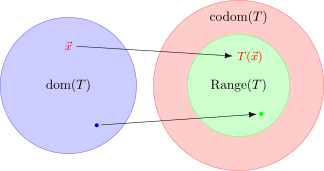
- The domain of $T$ is $\R^n $.
- The codomain of $T$ is $\R^m $.
- The image of $\vec{x}$ under $T$ is denoted $T(\vec{x})$ (which is in $\R^m $).
- The range of $T$ is the set of all images: $\Range (T) = \cbr{T(\vec{x}) \:\mid\: \vec{x} \in {\rm dom}(T)} $
We'll use the following notation: $T : \R^n \to \R^m \qquad \text{and} \qquad \vec{x} \mapsto T(\vec{x})$
- Find the image of $\vec{x} = \mat{c} x_1 \\ x_2 \rix$ under $T$.
- Find the image of $\vec{u} = \mat{r} 2 \\ -1 \rix$ under $T$.
- Find $\vec{x} \in \R ^2$ whose image is $\vec{b} = \mat{r} 3 \\ 2 \\ -5 \rix$.
We solve $A \vec{x} = \vec{b}$. That is, \[ \mat{rr|r} 1 & -3 & 3 \\ 3 & 5 & 2 \\ -1 & 7 & -5 \rix \qquad\qquad \begin{aligned} R_2 &\leftarrow R_2 - 3 R_1 \\[0.5em] R_3 & \leftarrow R_3 + R_1 \\[0.5em] R_2 & \leftarrow 1 / 14\cdot R_2 \\[0.5em] R_3 & \leftarrow R_3 -4R_2 \\[0.5em] R_1 & \leftarrow R_1 + 3 R_2 \end{aligned} \qquad\qquad \mat{rr|r} 1 & 0 & 1.5 \\ 0 & 1 & -0.5 \\ 0 & 0 & 0 \rix .\] Therefore, $\vec{x} = \mat{c} x_1 \\ x_2 \rix = $
- Is there more than one $\vec{x}$ such that $T (\vec{x}) = \vec{b}$?
- Is the vector $\vec{c} = \mat{c} 3 \\ 2 \\ 5 \rix$ in the range of $T$?
Recall : $A( \vec{u} + \vec{v}) = A \vec{u} + A \vec{v}$. Important to our discussion are transformations with this same property.
- $T (\vec{u} + \vec{v}) = T(\vec{u}) + T (\vec{v})$ for all $\vec{u}, \vec{v} \in {\rm dom}(T)$.
- $T(c \cdot \vec{u}) = c \cdot T(\vec{u})$ for all scalars $c$ and all $\vec{u} \in {\rm dom}(T)$.
Because of , every matrix transformation $T(\vec{x}) = A \vec{x}$ is a linear transformation.
- $T (\vec{0}) = \vec{0}$
- $T(c \cdot \vec{u} + d \cdot \vec{v}) = c \cdot T(\vec{u}) + d\cdot T(\vec{v})$ for all scalars $c,d$ and $\vec{u}, \vec{v} \in {\rm dom}(T)$.
Section 1.9: Matrix of a Linear Transformation
Note: We are not covering all the material in this section.
It turns out that every linear transformation can be described by a matrix transformation. This is extremely nontrivial to prove and requires more material than we will cover in this course.
But, it poses the question: how do we find the matrix?The $i$-th column of $I_n$ is denoted by the vector $\vec{e}_i \in \R^n$. For example, \[ I_3 \eq \mat{ccc} 1 & 0 & 0 \\ 0 & 1 & 0 \\ 0 & 0 & 1 \rix \eq \mat{ccc} \vec{e}_1 & \vec{e}_2 & \vec{e}_3 \rix .\] The identity matrix plays the role of $1$ in multiplication of real numbers: \[ I_3 \vec{x} \eq \mat{ccc} 1 & 0 & 0 \\ 0 & 1 & 0 \\ 0 & 0 & 1 \rix \mat{c} x_1 \\ x_2 \\ x_3 \rix \eq \mat{c} x_1 \\ x_2 \\ x_3 \rix \eq \vec{x} .\]
The columns $\vec{e}_i$ of the identity matrix allow us to find the matrix transformation that represents a linear transformation $T$, assuming we know $T(\vec{e}_i)$.
Suppose $T: \R ^2 \to \R ^3$ is a linear transformation and \[ T(\vec{e}_1) = \mat{r} 2 \\ -3 \\ 4 \rix, \qquad T(\vec{e}_2) = \mat{r} 5 \\ 0 \\ 1 \rix \qquad \text{where}\quad \vec{e}_1 = \mat{c} 1 \\ 0 \rix, \quad \vec{e}_2 = \mat{c} 0 \\ 1 \rix .\] What is $T(\vec{x})$ for any vector $\vec{x} = \mat{c} x_1 \\ x_2 \rix$?
Notice that any vector $x\in \R ^2$ can be written as \[ \mat{c} x_1 \\ x_2 \rix \eq \hspace{8em} \eq \hspace{8em} .\] Because $T$ is a linear transformation, then \begin{align*} T(\vec{x}) & \eq \hspace{7em} \eq \hspace{7em} \\[4em] & \eq \hspace{7em} + \hspace{7em} \\[4em] & \eq \hspace{8em} \\[4em] & \eq \hspace{8em} \\[4em] & \eq \end{align*}
(See Exercise 41 for a proof of the uniqueness of $A$.)
We call $A$ the standard matrix for the linear transformation $T$.