MTH 103 — Applied Precalculus
Part 1: True-False
The following are true-false questions. Circle true or false accordingly. No justification is required.
- If a quadratic function has horizontal intercepts at $x=-1$ and $x=1$, then the axis of symmetry is at $x=2$.
- A numerically given function is linear if the slope between any two distinct points is constant.
- A quadratic function with a vertex of $(4,5)$ has an axis of symmetry given by $x=4$.
- The slope of a vertical line is zero.
- The expression $(x+3)^2$ is equal to $x^2+3^2$.
- The function $f(x)=3x+4$ is an increasing function.
- The function $f(x)=2x+3$ has a horizontal intercept of $(3,0)$.
- The functions $f(x) = x^2 - 2x - 1$ and $g(x) = -x^2 + 2x + 1$ are quadratic functions that open in the same direction (i.e., both open upwards or both open downwards).
Part 2: Multiple Choice / Short Answer
Circle the best answer for each question, or fill in the blank(s).
-
Given $f(x)=\dfrac{3x-1}{2}$, then $f(x+h)$ is equal to
- $\dfrac{3x+h-1}{2}$
- $\dfrac{3x-3h}{2}$
- $\dfrac{3x+3h-1}{2}$
- $\dfrac{3x+h}{2}$
-
Let $C$ denote the number of calories in a candy bar. Let $w$ denote the weight in ounces of the candy bar. Suppose $C$ is a linear function of $w$ so that $C = f(w)$. What are the units for the slope of this function?
- ounces per calorie
- calories per ounce
- calories
- ounces
- Complete this sentence. If the product of three numbers is $0$, then at least one of the numbers is:
-
Suppose a quadratic function $g(x)$ has horizontal intercepts $(-1,0)$ and $(3,0)$. What can you say, with certainty, about the function?
- $g(x)$ opens upward
- $g(x)$ has a vertex at $(-1,0)$
- $g(x)$ has a line of symmetry of $x=1$
- $g(x)$ has a vertex of $(3,k)$ for some number $k$
- Write a formula for a function $f(x)$ which squares the input, multiplies the result by $3$, then adds $2$.
-
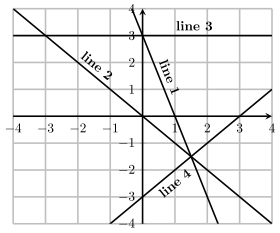
Four linear functions are given below, labeled “line 1” to “line 4”. Next to each formula write the number ($1$ through $4$) that corresponds to that equation.
\begin{align*} y=3 & \quad \text{corresponds to which line? } \\[1em] y=x-3 & \quad \text{corresponds to which line? } \\[1em] y=-3x+3 & \quad \text{corresponds to which line? } \\[1em] y=-x & \quad \text{corresponds to which line? } \\[1em] \end{align*}
-
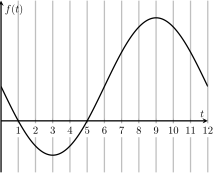
Consider the graph of a function $y=f(t)$ given below.
The average rate of change of $f(t)$ between $t=0$ and $t=3$ is
- negative
- positive
- zero
- cannot be determined
- negative
- positive
- zero
- cannot be determined
-
What is the domain of the function $f(x)=\sqrt{x+2} \,$?
- All numbers $x$ such that $x\ge -2$.
- All numbers $x$ such that $x\le -2$.
- All numbers $x$ such that $x\neq 2$.
- Only $x=2$.
-
If the following table describes a linear function, then determine its formula.
$x$ 1 2 3 4 $y$ 4.4 4.8 5.2 5.6 - Not a linear function
- $y=0.4x+4$
- $y=2.5x+1.9$
- $y=0.4x+4.4$
Part 3: Open Response Problems
Show all your work for each open response problem. No credit will be given for correct answers without supporting work.
-
The height, measured in feet, of a rock $t$ seconds after it was dropped from a bridge is described by the function $h(t) = -5t^2+80$.
- Find the vertical intercept of $h(t)$.
- Find the positive horizontal intercept of $h(t)$ (i.e., for $t\ge 0$).
- Which of the following best describes the vertical intercept?
- The height from which the rock was dropped.
- The amount of time that the rock fell for before hitting the ground.
- The speed of the rock when it hit the ground.
- The speed of the rock when it started falling.
- Which of the following best describes the positive horizontal intercept?
- The height from which the rock was dropped.
- The amount of time that the rock fell for before hitting the ground.
- The speed of the rock when it hit the ground.
- The speed of the rock when it started falling.
-
Factor each of the following quadratics into the form $(x+M)(x+N)$ for numbers $M$ and $N$, or state that they cannot be factored.
- $x^2+7x+12$
- $x^2-4$
- Data is collected for the height $p$ in centimeters (cm) of a plant $t$ months after it was planted. After $4$ months the plant is $110$ cm tall, and after $10$ months the plant is $230$ cm tall. Determine the linear function $p(t)$ that describes the height of the plant after $t$ months.
- Rewrite the function $f(x)=(x+3)^2-4$ in standard form.
-
The graph of a function $y=f(x)$ is given below.
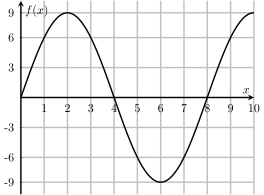
- List all input(s) $x$ for which $f(x)=6$.
- On what interval(s) is the function $f(x)$ increasing?
- On what interval(s) is the function $f(x)$ decreasing?
-
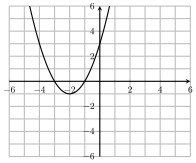
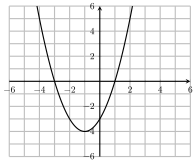
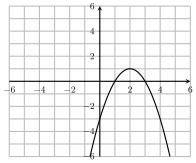
Let $g(x)=x^2+2x-3$.
- Write $g(x)$ in factored form:
- Does $g(x)$ open upwards or downwards? Write up or down.
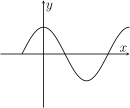
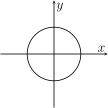
- Which of the following three graphs could be the graph of $g(x)$?
-
A gym charges new members a $\$30$ registration fee, and then $\$28$ per month.
- Determine the formula for the linear function $f(t)$ which gives the total amount, in dollars, you have paid if you have been a member for $t$ months.
- You cannot remember when you became a member, but have paid a total of $\$254$. How many months have passed since you joined?
- The balance (in dollars) in a savings account is described by $D(t) = 10t^2 + 3500$, where $t$ is the number of years since 2000. Find the average rate of change, including units, of $D$ between $t=0$ andd $t=16$.
-
For each of the following, write “yes” if the relationship describes a function and “no” if not.
$x$ 1 2 3 4 $y$ 6 3 6 2 $x$ $y$ 1 2 2 4 3 2 2 1